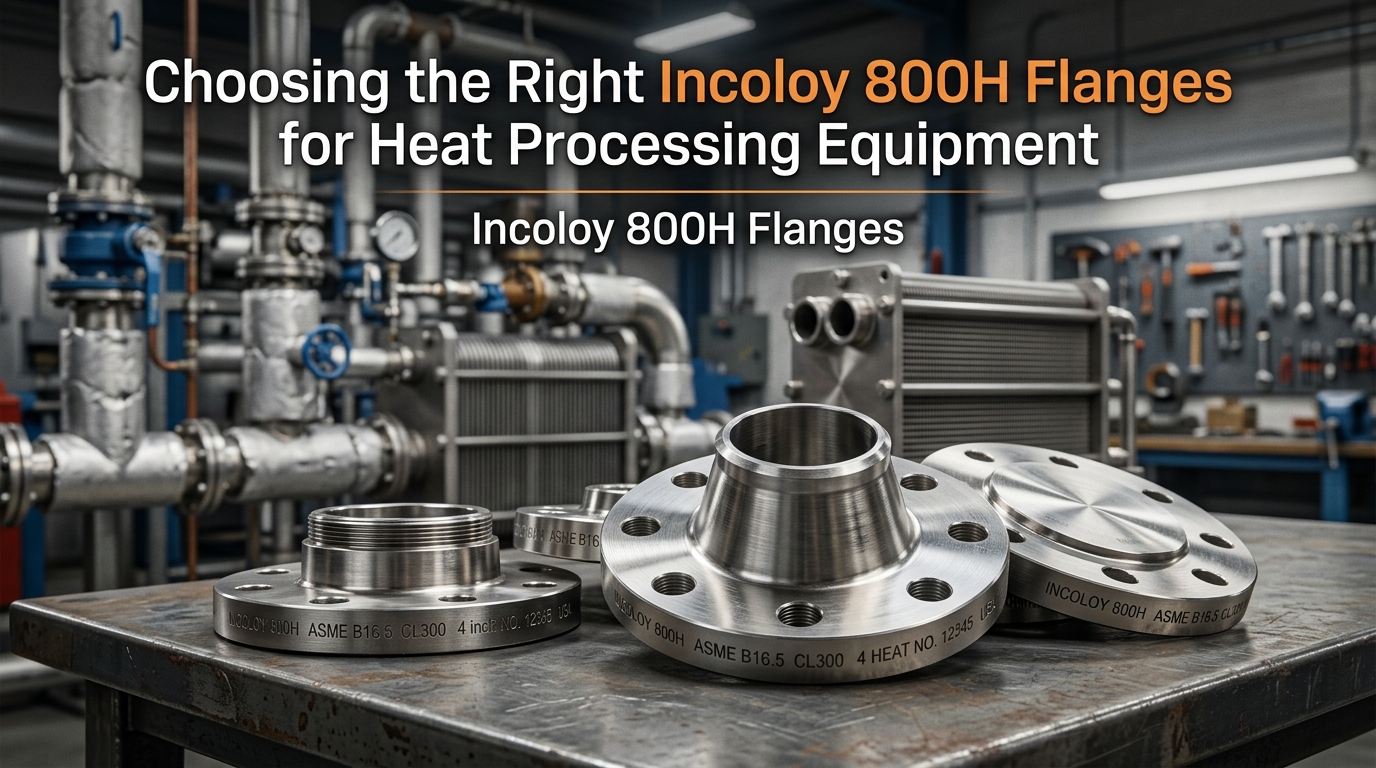
Introduction to Incoloy 800H Flanges
Industrial piping systems rely on flanges as the primary mechanical joints to connect pressure vessels, valves, and pipes. When operations involve extreme thermal environments, these components must withstand intense heat without sacrificing structural integrity. Engineered with a controlled carbon content between 0.05% and 0.10%, this nickel-iron-chromium alloy performs reliably at temperatures up to 1100°C, making it a premier choice for high-temperature process industries requiring Incoloy 800H Flanges.
Why Heat Processing Equipment Requires Specialized Flanges
Traditional stainless or standard carbon steel flanges cannot endure heat processing environments. Equipment in furnaces, reformers and thermal reactors is subjected to continuous high temperatures, where metal fatigue develops steadily, oxidation is active above 600°C and surface scaling deteriorates the integrity of joints when the base material contains insufficient chromium and nickel.
Differential expansion stresses at flange joints caused by thermal cycling can result in gasket failure or loosening of the bolts if the flange material does not have the same thermal expansion profile as the connected piping.
Key Material Properties of Incoloy 800H
The Incoloy 800H offers a unique combination of properties for heat resistant alloy flanges in high temperature piping applications.
- Incoloy 800H retains measurable creep strength at high temperature over 800°C, which resists deformation under steady mechanical load.
- Chromium contents of 19 to 23% forms a stable oxide layer, which limits oxidation at high temperatures.
- It is reliable in atmosphere containing hydrocarbons or carbon monoxide at high temperature due to its resistance to carburization.
- Controlled additions of aluminium and titanium provide metallurgical stability and the grain boundaries are not degraded with long term thermal exposure.
- Incoloy 800H components, as oxidation resistant alloy flanges, are dimensionally stable and do not suffer surface scaling over long service cycles.
Difference Between Incoloy 800H and Incoloy 800HT Flanges
Both grades share the same base alloy family, but their composition and temperature capability differ in ways that directly influence application suitability.
Incoloy 800H
Incoloy 800H carries carbon at 0.05% to 0.10% with an ASTM No. 5 or coarser grain size. It suits moderate creep conditions and oxidising service up to approximately 1100°C.
Incoloy 800HT Pipe Flanges
Incoloy 800HT pipe flanges add tighter controls on aluminium and titanium at 0.25% to 0.60%, improving creep-rupture strength above 980°C. They are preferred for the most thermally aggressive service conditions.
Types of Flanges Used in Heat Processing Systems
Flange geometry selection is as consequential as alloy selection in high-temperature systems.
Weld Neck Flanges
Weld neck flanges join the pipe via a full-penetration butt weld that distributes stress across a tapered hub. They are the most specified type in high-temperature piping.
Slip-On Flanges
Slip-on flanges are fillet welded at both the bore and face. Lower pressure ratings restrict them to moderate-temperature lines rather than primary high-heat circuits.
Blind Flanges
Blind flanges seal a piping run without a bore, providing inspection access and future extension points while maintaining pressure containment at operating temperature.
Socket Weld Flanges
Socket weld flanges accept small-diameter pipe into a recessed socket. They suit smaller bore lines but are inadvisable where severe thermal cycling occurs.
Threaded Flanges
Threaded flanges connect without welding and are restricted to low-pressure auxiliary lines. They are unsuitable for primary high-temperature piping due to leakage risk.
Importance of ASTM B564 Standards in Incoloy Flanges
ASTM B564 Incoloy Flanges are manufactured according to a specification that specifies the chemical composition and mechanical properties of nickel alloy forgings. The standard specifies the dimensional tolerances, heat treatment conditions and minimum tensile values, so the flanges from different manufacturers are compatible with each other without any issues of compatibility.
Certified compliance ties each heat of material to mill certificates, a requirement that is mandatory in pressure equipment directives in petrochemical, power generation and refining operations.
Factors to Consider When Selecting High Temperature Pipe Flanges
Choosing the right high temperature pipe flanges for a heat processing system requires evaluating several technical parameters before placing any order.
Operating Temperature
Sustained operation above 980°C should direct selection toward 800HT, where creep-rupture performance of both grades diverges significantly.
Pressure Rating
Flanges must meet ASME B16.5 or B16.47 ratings. As the temperature rises, allowable pressure drops and must be verified against actual operating data.
Thermal Expansion
Incoloy 800H has a thermal expansion coefficient of approximately 16.0 x 10⁻⁶/°C at 600°C. Joints must accommodate this without bolt pre-load loss.
Corrosive Environment
Streams carrying sulfur compounds or chlorides introduce corrosion mechanisms beyond oxidation. Process chemistry must be matched against published corrosion data.
Flange Compatibility with Piping Systems
Mismatched facing types, such as a raised face paired with a flat face, compromise gasket seating and create leak paths under thermal load.
Welding Requirements
Incoloy 800H requires controlled preheat and interpass temperature management. Matching filler metals, typically ERNiCr-3, must be specified in the welding procedure.
Common Applications of Incoloy 800H Flanges in Heat Processing Equipment
Industrial heat processing flanges in the 800H grade appear in high-temperature process systems where alloy stability cannot be compromised.
Furnaces
These flanges connect radiant tube burner piping and annealing furnace headers where metal temperatures routinely exceed 900°C.
Heat Exchangers
Incoloy 800H flanges provide nozzle connections at the most thermally stressed zones in shell-and-tube and fired heater configurations.
Petrochemical Plants
Steam reformer outlet pigtails and ethylene plant transfer lines rely on 800H flanges, where high temperature coincides with carbonaceous process gas.
Refineries
Hydrocracker and hydrogen production unit piping specifies these flanges where elevated hydrogen partial pressure and high temperature coexist.
Thermal Processing Units
Continuous carburising and nitriding furnace piping uses 800H flanges for documented resistance to atmosphere-related degradation.
Power Generation Systems
Waste heat recovery units and high-temperature steam lines in combined cycle plants use 800H flanges at junction points where thermal gradients are steepest.
Manufacturing and Quality Testing of Nickel Alloy Flanges
Reputable Incoloy 800H flanges manufacturers apply a structured testing protocol before dispatching any batch. A qualified nickel alloy flanges supplier documents each of the following checks.
- Positive material identification confirms alloy composition using X-ray fluorescence or optical emission spectrometry at the component level.
- Hydrostatic testing is used to verify the pressure integrity of the bore by pressurising it to a multiple of the rated working pressure.
- Ultrasonic testing is used to scan the forging body for internal discontinuities that are not visible by surface inspection.
- Dimensional inspection is performed to verify bore diameter, bolt circle, face finish and height per ASME or ASTM.
- Material traceability links each flange back to the original mill heat number for complete chain-of-custody verification.
Conclusion
Correct flange selection in heat processing systems directly affects equipment reliability and process safety. Incoloy 800H flanges offer a documented combination of creep resistance, oxidation stability, and metallurgical consistency that standard alloys cannot match at elevated service temperatures. Specifying the right grade, flange type, and certified material standard from the outset reduces the probability of in-service failure across the most thermally demanding environments in the process industry.