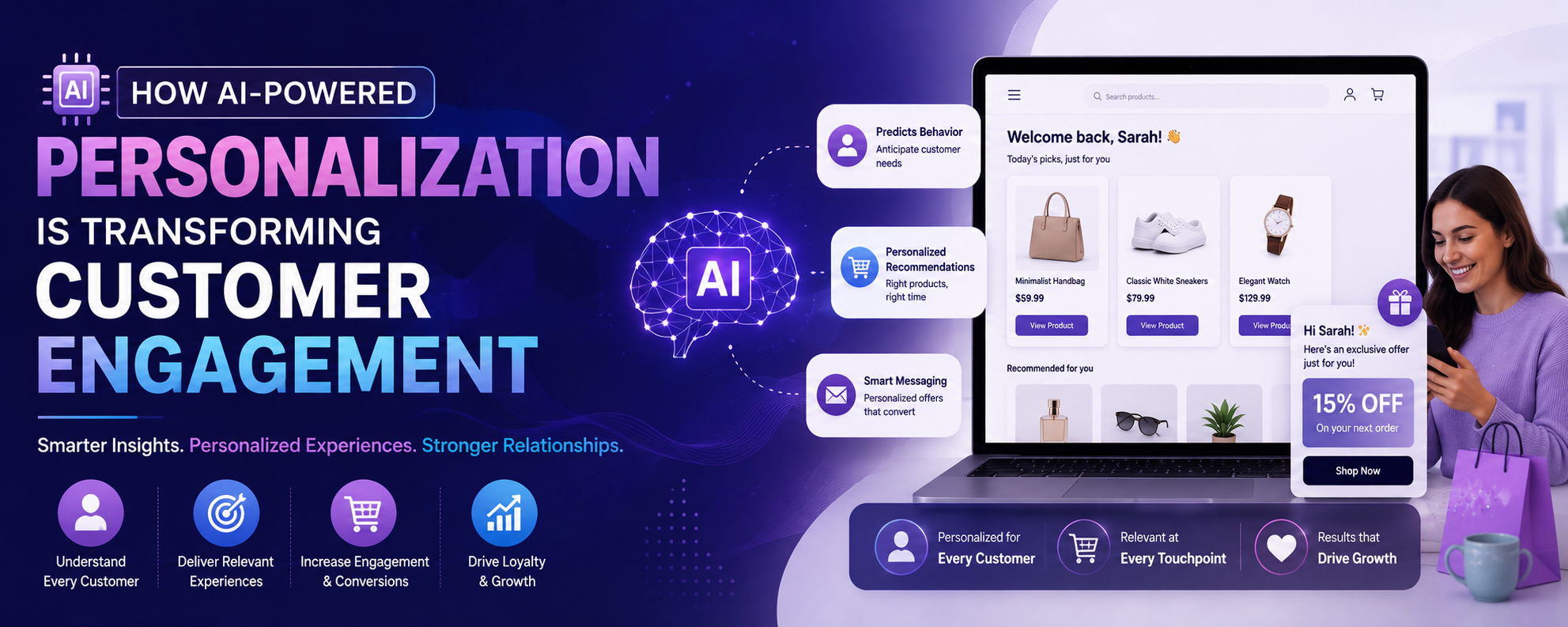
AI-powered personalization transforms customer engagement by delivering tailored content, product recommendations, and experiences in real time. For PrestaShop merchants, integrating a robust blog module is a strategic way to leverage AI, as it enables personalised content delivery, boosts SEO, and improves customer retention. This article outlines a step-by-step strategy to adopt AI personalization, from data collection to content that ranks and gets cited by AI engines. By the end, you will have a practical roadmap to implement AI personalization in your store, lift engagement, and turn more visitors into repeat customers.
The stakes are higher than most store owners realise. According to McKinsey research, 71 percent of consumers now expect companies to deliver personalised interactions, and 76 percent get frustrated when that expectation is not met. Yet the gap between expectation and delivery remains wide: Deloitte found that consumers recognised only 43 percent of their brand experiences as genuinely personalised, while brands believed they were personalising far more. That disconnect is not a minor annoyance. It is a measurable competitive weakness.
For merchants, the battleground is not just email subject lines or a homepage banner. It is the content engine that feeds your store’s authority, relevance, and ability to answer the questions your customers actually ask. Generic product descriptions and category pages no longer cut it. Search engines and AI assistants now reward stores that publish fresh, structured, genuinely useful content tailored to buyer intent.
The business case is compelling. Industry analysis projects the global AI ecommerce market could reach $74 billion by 2034, with AI-referred traffic to U.S. retail growing at dramatic year-over-year rates. Meanwhile, ecommerce personalization data shows that 71 percent of consumers expect personalised experiences, yet most stores still serve the same static content to every visitor. The winners will be the merchants who use AI to close that gap quickly.
The store that treats personalization as a content strategy, not just a recommendation widget, will win both Google rankings and AI-assistant citations.
This shift matters for another reason: personalization budgets are exploding. Forecasts indicate ecommerce personalization software will grow from $263 million to $2.4 billion by 2033, and 89 percent of business leaders already call personalization invaluable to their success. For PrestaShop merchants, the practical implication is straightforward: invest in the tools and workflows that let you publish personalised, AI-generated content at scale, or watch competitors capture the traffic you should be earning.
The good news is that you do not need a data science team or a six-figure martech stack. A well-chosen blog module, combined with the AI capabilities now built into modern modules, lets you create content that serves both search engines and the AI assistants that increasingly mediate buying decisions. The sections that follow walk through the specific strategies, tools, and implementation steps to make that happen in your store.
How Does AI Personalize Content for Ecommerce?
AI personalization in ecommerce works by replacing the old “one message for everyone” approach with content that adapts to each visitor. Instead of guessing what a shopper wants, the system learns from their behaviour and adjusts your store’s content in real time. This matters becausethe gap between customer expectations and reality is wide: 71 percent of consumers expect personalised interactions, and 76 percent get frustrated when it doesn’t happen.
The process runs on four connected layers, each building on the previous one:
- Data collection. Every action on your store becomes a data point. This includes pages viewed, time spent on each product, search queries typed, items added to cart, purchase history, and even how far a visitor scrolls down a blog post. First-party data from your own site is the most reliable signal because it reflects real intent, not inferred demographics.
- Segmentation. Raw data is grouped into meaningful clusters. Rather than broad categories like “women” or “men”, modern segmentation is behavioural: “first-time visitors who browsed camping gear but didn’t purchase”, or “returning customers who bought a coffee machine in the past 90 days”. These segments allow you to tailor content without treating every visitor as an individual case.
- Algorithm-driven recommendations. Machine learning models analyse patterns across thousands of sessions to predict what a specific visitor is likely to engage with next. This powers product recommendations, related articles, and dynamic blocks that change based on where the shopper is in their journey.
- Real-time adaptation. The system continuously updates as new data arrives. If a visitor starts reading about winter running shoes, the sidebar, homepage banner, and recommended posts adjust immediately. This is what separates true personalization from static rules like “show this to everyone from London”.
For merchants, the practical application usually starts with content. A powerful blog module becomes the engine for this because written articles are easy to tag, categorise, and serve conditionally. When you pair a content management system with AI generation, you can produce tailored posts for different segments: a beginner’s guide for first-time visitors, a comparison article for shoppers comparing two models, and an advanced maintenance guide for repeat buyers.
One common misconception is that personalization requires a fully custom build. In practice, most merchants achieve strong results by combining their store’s native customer data features with a capable blog module. The key is to start with a clear content strategy, then let the AI handle the heavy lifting of matching each article to the right segment at the right moment.
The PrestaShop Advantage: Blog Module as Your Personalization Engine
For PrestaShop merchants looking to adopt AI personalization, the AI Blog Module with ChatGPT & Gemini is the top pick. It helps you attract more traffic to your store and increase sales. You can easily install it without coding and start publishing SEO-optimised articles, product reviews, AI-generated posts, and more right away. This matters because 71 percent of consumers expect companies to deliver personalised interactions and 76 percent feel frustrated when that expectation is missed.
Here is how the right module turns your storefront into a personalization engine rather than a static catalogue.
Content Segmentation Without Custom Development
Most PrestaShop themes treat a blog as a single stream of posts. A dedicated blog module changes that by letting you organise content into categories, tags, and author profiles. From a personalization standpoint, that structure is gold. It lets you serve different visitors different article collections based on what they have already viewed or purchased. For example, a returning customer who bought running shoes can be guided toward posts on training plans or shoe care, while a first-time visitor sees brand introductions and size guides.
The practical benefit is that segmentation becomes a matter of tagging content, not commissioning custom code. You can test which topics resonate with which audience segments and adjust your editorial calendar accordingly.
Multi-Language and Multi-Store Personalization
PrestaShop’s architecture already supports multi-store and multi-language setups. The challenge is keeping content consistent across those contexts without duplicating effort. A capable blog module integrates with language packs so that articles, categories, and even URL slugs are translated and localised. This matters for personalization because a shopper in Madrid browsing your Spanish store page should encounter Spanish-language articles that reference local delivery options, not generic English content.
When your blog respects the shopper’s language and regional context, you are personalizing at the most basic level: speaking to them in their own language. That single change often lifts engagement metrics more than any complex recommendation algorithm.
SEO Structure That Personalization Depends On
Personalization only works if visitors can find your content in the first place. This is where the SEO mechanics of a blog module become the backbone of your strategy. Look for modules that give you control over meta titles, meta descriptions, friendly URLs, and internal linking. These are the elements that help Google understand your content and serve it to the right queries. When your blog posts rank for long-tail keywords, you attract visitors who already have a specific intent, which makes your personalization efforts far more effective.
A well-structured blog module also generates clean sitemaps and supports schema markup, both of which improve your store’s visibility in search results and AI-generated answers.
Why This Becomes Your AI Axis
Personalization engines need content to serve. AI tools can generate posts, but they need a system that can publish, organise, and present that content contextually. The AI Blog Module with ChatGPT & Gemini combines content generation with the structural features above. With its new AI Blog Generation feature supporting ChatGPT and Gemini, you can instantly create high-quality blog posts, product reviews, FAQs, and article ideas. You can create SEO-optimised articles and product reviews directly within your admin, then publish them in the correct language and category without touching code.
The impact is measurable:
- Fresh, relevant content keeps shoppers returning and signals relevance to search engines.
- Category and tag structures allow you to match content to visitor behaviour.
- Multi-language support ensures personalization extends beyond surface-level product recommendations.
In effect, the blog module becomes the distribution layer for your AI personalization strategy, connecting generated content to the shoppers who will find it most useful.
A Step-by-Step Strategy to Implement AI Personalization in PrestaShop
Implementing an AI personalization ecommerce strategy in PrestaShop doesn’t require a complete rebuild of your store. It requires a deliberate sequence of steps that build on each other. By following this five-step roadmap, you can move from generic content to a store that feels genuinely tailored to each visitor.
Step 1: Collect First-Party Data Intentionally
Every personalization effort begins with data. In PrestaShop, your back office already holds valuable signals: purchase history, abandoned carts, product views, and customer account details. The key is to capture this information deliberately rather than passively.
Start by enabling guest tracking so you can record browsing behaviour before someone creates an account. Use PrestaShop’s native customer groups to tag users by behaviour, such as “high-value repeat buyers” or “first-time visitors.” If you run email marketing through a service like Mailchimp or Klaviyo, sync your customer data to enrich profiles with engagement metrics.
The quality of your AI outputs depends entirely on the quality of your inputs. The AI Blog Module with ChatGPT & Gemini helps here by generating article ideas based on the products and categories you already sell, giving you a structured way to build content around the data you collect.
Step 2: Segment Audiences by Behaviour, Not Demographics
Traditional demographic segmentation (age, gender, location) tells you who your customer is, but not what they want right now. Behavioural segmentation is far more powerful because it responds to real-time intent.
Create segments based on actions rather than attributes:
- Browse abandonment: visitors who viewed a product but left without adding it to the cart
- Cart abandonment: customers who added items but didn’t complete checkout
- Category affinity: shoppers who repeatedly view products in a specific category, such as outdoor gear or skincare
- Purchase recency: customers who haven’t ordered in 30, 60, or 90 days
- Loyalty tier: repeat buyers who qualify for exclusive offers or early access
These segments give you the foundation for personalised content. A customer who abandoned their cart three times needs a different message than a first-time visitor exploring your store.
Step 3: Create AI-Ready Content at Scale
Personalization fails when you only have one version of your content. To serve different segments, you need variations of product descriptions, category pages, and blog articles that speak to each audience’s concerns. This is where AI-powered content generation becomes essential.
Instead of writing manually, use a module to produce multiple content variations quickly. The AI Blog Module with ChatGPT & Gemini lets you generate SEO-optimised articles, product reviews, and FAQs directly from your PrestaShop dashboard. You can create content that addresses specific segments: a beginner’s guide to hiking boots for new outdoor enthusiasts, and a technical comparison for experienced trekkers.
Each piece of AI-generated content should be reviewed and edited by a human before publishing. AI provides the draft; you provide the brand voice, factual accuracy, and final polish.
Step 4: Deploy Personalization Rules in PrestaShop
With your segments defined and content ready, you can now connect the two. PrestaShop allows you to display different content blocks based on customer group, cart contents, or browsing history. Set up rules that match your segments to the relevant content.
A practical example: for visitors in the “cart abandonment” segment, display a blog article titled “5 Reasons Your Cart Items Are Worth Every Penny” alongside a related product recommendation block. For first-time visitors, show a welcome guide that explains your brand story and best-selling categories.
Your blog module becomes central here. Since it integrates directly with PrestaShop, you can link personalised articles to product pages, category pages, and even trigger them based on the customer’s current session. This keeps the experience seamless, no redirects or external platforms required.
Step 5: Test, Measure, and Optimise Continuously
Personalization is not a set-and-forget activity. What resonates with one segment this month may fall flat next quarter. Build a testing routine into your workflow.
Track these metrics weekly:
| Metric | What It Tells You | Action If It Declines |
| Click-through rate on personalised content | Whether your content matches audience interest | Refresh headlines and refresh topics |
| Conversion rate per segment | Whether personalised recommendations drive purchases | Adjust product pairings and offers |
| Average order value per segment | Whether cross-sell and upsell content works | Test different product combinations |
| Time on page for blog articles | Whether content holds attention | Improve formatting and add internal links |
Use A/B testing where possible. Serve one segment the AI-generated article and another segment a manually written version, then compare engagement. Over time, you will learn which content structures, tones, and topics perform best for each audience group.
Refinement should also extend to your data collection. If you notice that certain customer groups consistently ignore your content, investigate whether their data profiles are complete. Sometimes the issue is a missing field or an outdated segment definition, not the content itself.
The goal is a virtuous cycle: better data leads to better segments, which leads to better content, which leads to more engagement, which produces more data. The AI Blog Module with ChatGPT & Gemini accelerates this cycle by reducing the time it takes to produce and publish relevant content for each segment. Start with one customer segment, publish three tailored articles, and measure the response before scaling to the rest of your store.
How Does Multilingual Blog Content Boost Engagement and SEO?
If you run an ecommerce store, your customers are likely not all browsing in the same language. A significant portion of your potential revenue sits in markets where your default language creates a barrier. Multilingual blog content removes that barrier, and it directly supports AI personalization ecommerce strategies by letting you tailor the reading experience to each visitor’s language and cultural context.
Personalization is not just about recommending the right product. It is about communicating in the way your customer understands best. A visitor reading a product guide in their native language is far more likely to trust your brand and complete a purchase. When your blog speaks their language, every piece of content becomes a personalised touchpoint, from the first search to the final checkout.
From an SEO standpoint, multilingual blogs multiply your opportunities. Each language version of an article targets different search queries in different regions. Instead of competing for one keyword, you compete for several, often with less competition in non-English markets. Search engines reward stores that deliver locally relevant content, which typically leads to higher rankings in those specific regions.
AI answer engines also favour multilingual content. When a system like ChatGPT or Google AI Overviews sources answers, it looks for content that matches the user’s language and location. If your blog publishes quality articles in multiple languages, it becomes a more valuable citation source for those queries. This extends your reach beyond Google rankings into the growing world of generative engine results.
To make this work on PrestaShop, you need a blog setup that handles translations cleanly. The AI Blog Module supports this workflow by generating posts that you can adapt for different language markets. The module helps you produce the base article in one language, then you can translate and localise it efficiently without rebuilding your whole content process.
Practical steps to get started with multilingual blogging:
- Identify your top three target markets based on current traffic and shipping destinations.
- Translate your highest-performing articles first, focusing on content that already drives sales.
- Localise images, examples, and currency references, not just the text itself.
- Set up clean URL structures for each language to help search engines index them separately.
- Monitor engagement per language to see which markets respond best to your content.
Multilingual content is not optional for stores with international ambitions. It is the bridge between a generic storefront and a genuinely personalised experience that performs well in search engines and AI-driven discovery. Start with your best articles, localise them properly, and watch your international engagement grow.
What Metrics Prove Your AI Personalization Is Working?
Measuring the impact of AI personalization on ecommerce strategies requires tracking the right metrics. Without clear KPIs, you risk optimising for the wrong signals or missing the disconnect between what you think you deliver and what customers actually experience.
The core metrics fall into four categories: engagement depth, conversion behaviour, customer loyalty, and AI-assistant visibility. Track them in PrestaShop using your back office statistics, Google Analytics 4, and your PrestaShop AI Blog Module with ChatGPT & Gemini analytics.
Benchmarks vary by industry, but a healthy engagement rate for blog content typically falls between 30 and 45 percent, and average time on page should exceed two minutes for in-depth articles. Conversion rates of 1-3 percent remain standard for ecommerce, though personalised product recommendations often lift this to 4-5 percent.
The AI-citation metric deserves special attention. As Deloitte Digital reports surveyed consumers recognised only 43 percent of their experiences as personalised, while brands believed they personalised far more. This gap means you should track whether ChatGPT, Perplexity, or Google AI Overviews quote your blog content when shoppers ask product questions. If your personalised articles answer specific queries clearly and cite concrete data, you earn visibility in these AI-generated answers without paying for advertising.
Set a monthly review cycle in your CMS. Compare these metrics against the baseline before you implemented AI personalization, then look for steady improvement across all five KPIs rather than focusing on any single one.
Future-Proofing: Where AI Personalization Is Headed Next
AI personalization in ecommerce is evolving faster than most store owners realise. What feels cutting-edge today will become the baseline expectation tomorrow, so the merchants who win are the ones who adopt flexible systems now rather than rebuilding later.Your store needs personalization technology that can grow with these shifts, not one that locks you into a single approach.
Predictive analytics is already reshaping how stores anticipate customer behaviour. Instead of reacting to what shoppers do, machine learning models study historical data to forecast what they will do next, whether that is which products a repeat customer is likely to buy or when a casual visitor is closest to converting. This moves personalization from a reactive tactic to a proactive strategy, and it rewards merchants who gather rich content data over time.
Generative AI is perhaps the most visible shift. Tools like ChatGPT and Gemini now handle heavy lifting that used to require external writers and agencies: drafting blog posts, product round-ups, buying guides, and even FAQ sections tailored to specific customer segments. When you pair generative AI with a solid content strategy, you can publish personalised articles at a scale that was simply unaffordable before. The AI Blog Module was built with this exact trajectory in mind, so the content engine you deploy today will still be relevant as these models improve.
Voice search is another frontier that quietly changes the rules. Shoppers increasingly ask smart speakers and voice assistants for recommendations, and those queries tend to be longer, more conversational, and phrased as full questions. That makes the blog content strategy above even more valuable, because natural-language posts are exactly what voice assistants quote back to users.
- Predictive analytics turns browsing history into forward-looking recommendations.
- Generative AI content lets you personalise articles, reviews, and FAQs for different audiences.
- Voice search rewards conversational, question-based content that mirrors how people speak.
Personalization at scale is the thread connecting all of these trends. The merchants who thrive will be those who use AI to deliver relevant experiences to thousands of visitors simultaneously, without manually crafting each touchpoint. A blog module that fuses natural AI generation with PrestaShop’s built-in customer data puts you in a strong position to ride that wave rather than chase it later.
Why This Matters
The shift toward personalization is not a passing trend; it is a structural change in how people shop online. Shoppers now compare their experience in your store with their experience on Amazon, Netflix, and Spotify. When your store feels generic, they leave. When it feels tailored, they buy more and come back.
- Higher conversion rates: Personalised product recommendations and content match what a visitor is already looking for, shortening the path to checkout.
- Increased average order value: AI-driven cross-sell and upsell suggestions add relevant items to the basket before checkout.
- Better customer retention: Returning customers who see relevant content and offers are more likely to stay loyal to one brand.
- Improved customer experience: Shoppers feel understood when the store remembers their preferences, sizes, and browsing history.
- Reduced cart abandonment: Personalised follow-up emails and on-site messages can bring back shoppers who left without buying.
- Efficient marketing spend: Showing the right message to the right person reduces wasted advertising budget.
- Competitive advantage: Over 90% of companies globally now operate with some form of personalization, so standing still means falling behind.
Quick Wins
You do not need a full AI stack to start seeing results. These small changes can be implemented this week and will immediately improve how personalised your store feels.
- Use browsing history for product recommendations: Show “Recently viewed” and “Inspired by your browsing” blocks on category and product pages.
- Send a personalised cart abandonment email: Include the exact items left in the cart, not just a generic reminder.
- Segment your newsletter list by purchase behaviour: Send a different welcome email to first-time buyers than to repeat customers.
- Personalise the homepage hero banner: Show a different banner to new visitors (best sellers) than to returning ones (new arrivals).
- Add a product recommendation widget to the thank-you page: Suggest items that pair well with what was just purchased.
- Use AI to generate SEO-friendly blog posts: Automatically recommend relevant posts on product pages based on the product category.
Use AI to Personalise Product Recommendations
Product recommendations are the most direct and high-impact form of AI personalization. A recommendation engine analyses customer behaviour, purchase history, and product affinities to show the right products at the right moment. This is the difference between a shopper seeing 50 products and seeing 5 that are genuinely relevant to them.
The most profitable place to start is your homepage and product pages. Instead of showing a static “Featured products” grid, use AI to display “Customers also bought” and “You might like” blocks. These blocks should be based on real-time browsing behaviour, not just manual curation.
To implement this effectively in your stores, you can enable the native “Best Sellers” and “Customers who bought this also bought” modules, but they only use basic rules. For a more sophisticated approach, connect a third-party recommendation engine or use an AI-driven module that learns from every click on your store. Crucially, make sure the recommendations update after each visit, so a returning customer sees something different from a first-time visitor.
Use AI to Generate Personalised Content
Personalization extends beyond product recommendations to the content you publish. A blog post that is relevant to a shopper’s question can be the difference between a sale and a bounce. AI-powered content generation lets you create SEO-optimised articles, product reviews, and FAQs at scale, which means you can cover more buyer questions and topics than any human team could consistently produce.
For example, if you sell camping gear, an AI tool can help you write a blog post on “How to choose a tent for rainy weather” that speaks directly to shoppers searching for that query. This post can then be personalised further: on the tent product page, you display the blog post as “Buying guide” context. On the rain jacket page, you show a different post. The same underlying content library becomes a personalised content engine.
The AI Blog Module with ChatGPT & Gemini is built for exactly this scenario. It allows you to install a blog on your PrestaShop store without coding and publish AI-generated, SEO-optimised posts, product reviews, and FAQs. The module supports both ChatGPT and Gemini, so you can generate high-quality draft articles in minutes, then personalise the tone to match your brand. Because the module is a native module, it integrates with your existing product catalogue, making it easy to link articles to relevant product pages.
Use AI to Segment Customers and Send Targeted Emails
Email marketing remains one of the highest ROI channels in ecommerce, but only if the content is relevant. Sending the same newsletter to your entire list is a waste of time. AI segmentation helps you group customers based on their behaviour, such as purchase frequency, average order value, browsing history, and even predicted lifetime value.
With these segments, you can craft targeted campaigns. For example, a “highly engaged but no purchase in 90 days” segment might receive a win-back email with a personalised discount on their previously viewed items. A “VIP” segment receives early access to new collections. A “cart abandoners” segment receives a sequence of three emails that reference the exact products left behind.
Common Mistakes
Even with the right tools, many merchants undermine their own personalization efforts. These mistakes are common, but they are also avoidable once you know what to look for.
- Collecting data without a plan: Gathering browsing history and purchase data is pointless if you never use it to inform content or recommendations. The fix is to define the segments you want to serve before you start collecting data.
- Treating all visitors the same: Showing the same homepage, products, and blog posts to first-time visitors and repeat buyers wastes the opportunity to move shoppers down the funnel. Use customer groups to vary what each segment sees.
- Publishing AI content without human review: Raw AI output can contain inaccuracies, awkward phrasing, or off-brand claims. Always review and edit before publishing to protect your credibility.
- Ignoring multilingual audiences: If you ship internationally but only publish in one language, you are excluding a large portion of potential buyers. Localise your best content for your top markets first.
- Measuring only sales: Focusing exclusively on conversion rate misses engagement signals like time on page and repeat visits, which predict long-term loyalty. Track a balanced set of KPIs instead.
- Setting and forgetting: Personalization rules that worked last quarter may not work this quarter. Review your segments, content, and offers monthly to keep them relevant.
Implementation Roadmap
Follow this practical sequence to implement AI personalization in your PrestaShop store without getting overwhelmed. Each step builds on the previous one, so you can start small and expand as you see results.
- Install a capable blog module. Choose the AI Blog Module with ChatGPT & Gemini, so you have the content engine in place from day one.
- Audit your existing customer data. Review what behavioural and purchase data you already have, and identify gaps you need to fill.
- Define 3-5 customer segments. Start with behavioural groups like cart abandoners, first-time visitors, repeat buyers, and lapsed customers.
- Generate tailored content for each segment. Use AI to draft articles, product reviews, and FAQs that address each segment’s specific questions and concerns.
- Set up personalization rules. Connect your segments to the content blocks and recommendations you want each group to see.
- Launch with a single segment. Test your personalization on one customer group, measure the response, and refine before rolling out to other segments.
- Monitor and optimise monthly. Review your KPIs, refresh underperforming content, and adjust your segments based on new behavioural data.
Recommended Tools & Resources
You do not need a massive tech stack to implement AI personalization in PrestaShop. These tools cover the core capabilities: content generation, content publishing, and customer segmentation.
- PrestaShop AI Blog Module with ChatGPT & Gemini for AI-generated articles, product reviews, and FAQs directly inside your admin.
- PrestaShop native customer groups and statistics for behavioural segmentation and purchase tracking.
- Google Analytics 4 for measuring engagement metrics like time on page and repeat visit rates.
- Mailchimp or Klaviyo for syncing PrestaShop customer data into targeted email campaigns.
- ChatGPT or Gemini directly, if you prefer to draft content outside and paste it into your blog module.