In today’s world, the technical textiles sector has become one of the most revolutionary and prospective sectors of the world textile industry. In recent times, the technical textiles have gone far beyond being simply a niche product and on the contrary, is referred to as one of the most rapidly developing and strategically important segment of the world textile industry.
As compared to traditional textiles whose major aim is simply to look good and feel comfortable to wear, technical textiles are created in order to perform some certain tasks and functions. Thus, technical textiles are used in a variety of fields ranging from healthcare and construction to automotive, agricultural, aerospace and defence industries.
One of the key contributors to the rise of the technical textiles industry is the continuous advancement in technology. New technologies like smart textiles, nanotechnology and advanced fibres allow textiles to possess advanced properties such as temperature regulation, health tracking and environment sensing.
With the changing needs of industries and increasing demands for advanced materials, it is quite possible that technical textiles will become vital to the development of international manufacturing processes and global economies. With applications ranging from healthcare to aerospace, the sector offers multiple high-value growth opportunities for businesses, investors and policymakers.
Rapid Market Expansion
Market expansion is undoubtedly the biggest trend in the technical textiles industry that makes this sector very appealing for business people and investors.
In recent years, there has been continuous and consistent growth observed in the market worldwide due to an increase in demand for special-purpose materials with outstanding characteristics.
As opposed to traditional textiles that are usually driven by the fashion industry, technical textiles have their use cases within critical industries such as healthcare, construction, infrastructure and transport, which adds stability to the growth of this industry and ensures long-term sustainability.
The growth and development of infrastructure in the emerging markets of the world is one of the key reasons why technical textiles have become popular lately. The countries of Asia Pacific, particularly India and China, are investing significantly in building roads, railways, smart cities and factories, which in turn raises the need for geotextiles, insulation materials and protection fabrics.
Smart and Wearable Textiles
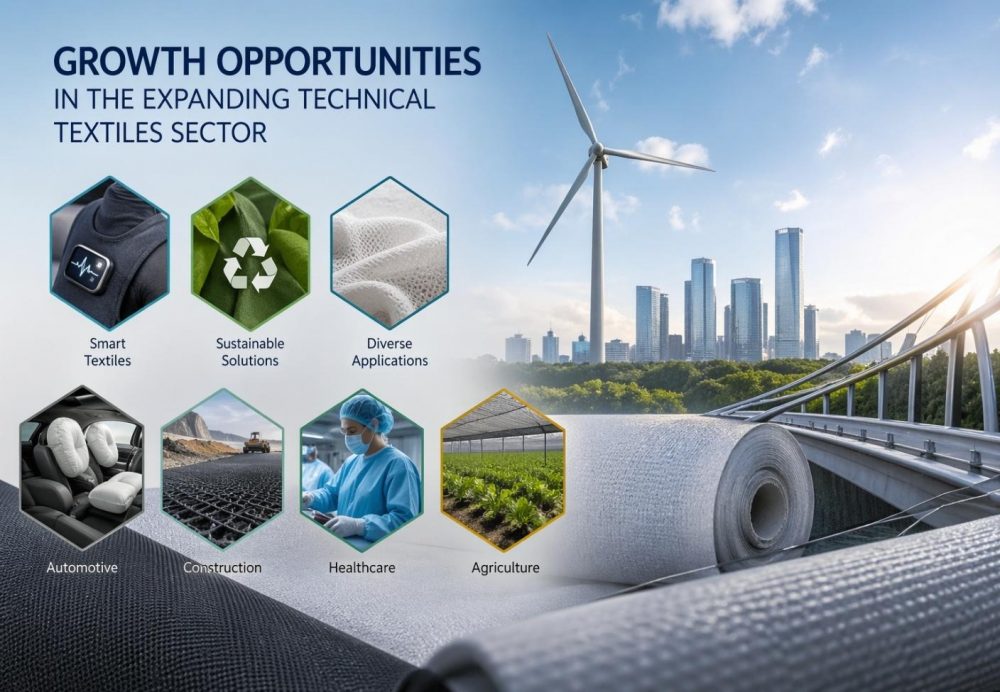
It is clear that wearable and smart textiles constitute one of the most innovative, highly technological and rapidly growing sub-segments within the technical textiles segment. These textiles contain sensors, micro-chips and conductive fibres, which allows them to respond to changes in the environment or input from the individual wearing them.
In the healthcare sector, these types of textiles allow patients’ vital signs to be monitored continuously without having to depend upon physical and traditional equipment. In a similar way, in the sports and fitness industry, these textiles allow monitoring of movements and postures for better performance with less risk of injuries. Likewise in the defence sector, the safety of military personnel can be increased by monitoring their health or any dangers in the surroundings.
Overall, the intelligent and wearables textiles are no longer a distinct invention to be made in the future, but rather a game-changing opportunity in the area of technical textiles and with the rapidly increasing technology, this sector will witness fast growth in its future course.
Diverse application areas
Unlike traditional fabric products, the demand for technical textile products does not solely rely on one industry and hence, the market is steady and constantly growing.
Technical textiles find widespread usage in automotive industries with their application ranging from seat belts, airbags and insulation, thus offering increased safety while also reducing the car’s total weight and improving the vehicle’s efficiency. Agricultural industries utilize technical textiles to protect crops against harsh weather elements such as strong sunlight and insects.
Construction industry also benefits greatly from technical textiles through the use of geotextiles that strengthen roads, bridges, and drainage. Healthcare industry is among sectors with high demand for technical textiles. Examples include medical garments such as gowns, masks and protective suits used in surgery and protection against infection and contamination.
Therefore, the vast applications in various sectors ensure steady demand for technical textiles, making the industry very resilient and promising in terms of development.
Sustainability and Eco-Friendly Features
At present, one of the most influential drivers of growth in the technical textiles industry is related to the emergence of sustainable materials and environment friendly features associated with the industry.
With the growing problem of pollution, natural resources scarcity and climate changes, firms pay attention to developing sustainable materials as well as manufacturing products using sustainable techniques.
Additionally, the approach of circular economics is widely recognized and stimulates the development of items which are recyclable and can be used again after their first use period. It refers primarily to those sectors that deal with the application of disposable products, like healthcare and packaging.
Lastly, governmental initiatives as well as norms established on the international level encourage firms to apply sustainability principles and make it a necessity for their business models.
Thus, firms that prioritize innovations within sustainable production will gain a competitive advantage, which in return, will open the door to new markets and product design opportunities.
Conclusion
In essence, the technical textiles sector plays an important role in promoting growth and development within industries in the current economy. The fast market expansion and growth in terms of infrastructure and industrial use proves that the sector has sustainable capabilities.
At the same time, sustainability and green materials are additional strengths for the industry due to increased global efforts to preserve the environment.
To conclude, it can be stated that the technical textiles industry will contribute to the economic development in the future due to innovations and support from various governments.