The quality, durability, and appearance of a finished metal component can be directly influenced by the preparation of a surface. Before painting, coating, or other processing, rust, mill scale, old paint, weld spatter, and other contaminants must be removed. With increasing production volumes, this is not consistently feasible by manual methods.
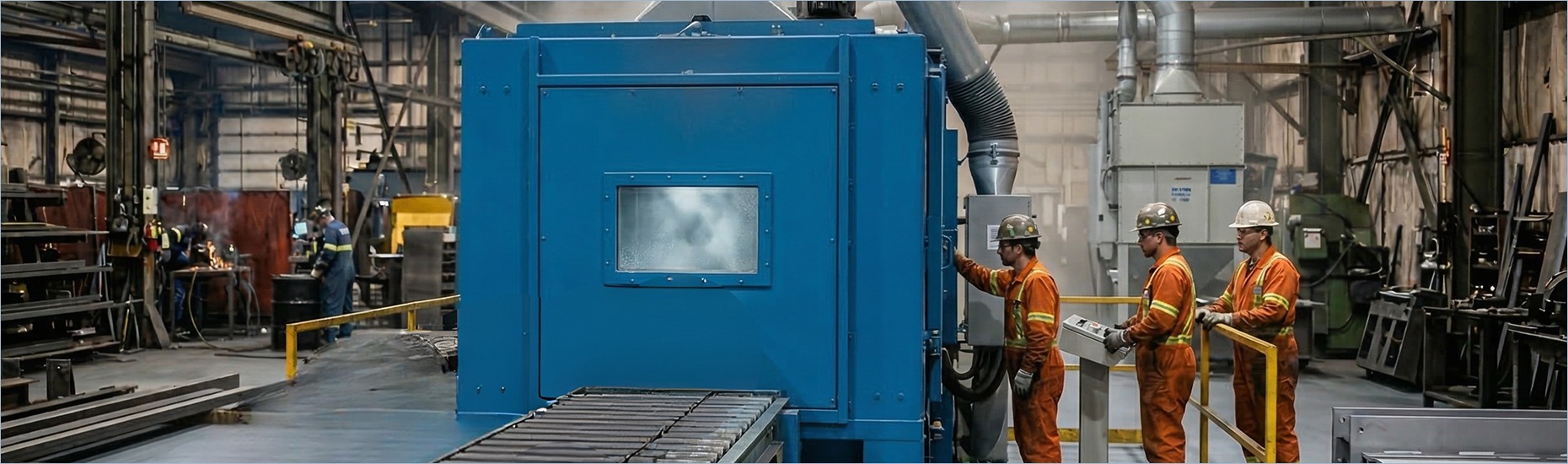
This is when a shot blasting machine enters manufacturing. It does this through the use of a machine, which catapults abrasive media at the component in a more reliable and reproducible way than many other forms of surface cleaning and prep.
It should, however, be borne in mind that not every machine suits every part; selection must take into account the nature of the part, the manufacturing process, and the required finish.
What Does a Shot Blasting Machine Do?
In a shot blasting machine, shot steel or grit steel can be applied as an abrasive. By means of special blasting devices, the material is sent to the object at a certain velocity. Depending on how it is used, by means of an air blaster system or a blasting wheel.
It can blast and remove old coatings, rust, scale, and old lubricants from metal surfaces. It also prepares surfaces for coatings and promotes better adhesion.
For manufacturers processing large quantities of similar parts, automated shot blasting machines can offer a more consistent alternative to manual surface preparation.
Understanding Different Shot Blasting Machine Types
One of the first steps in choosing equipment is understanding the shot blasting machine types available for different production requirements.
Tumble Type Machines
Tumble type systems are suitable for small parts which will be processed in batches. Small parts are loaded into a rotary drum or rubber belt, where they are constantly treated with abrasive media. These machines are ideal for the treatment of forgings, castings, screws or fasteners, and other small to medium-sized parts.
Hanger-Type Machines
Hanger systems provide optimal results for the largest and most complicated geometries to blast large parts, preventing collision. These parts are suspended on hooks, as only a proportion of the component has to be exposed to be contacted by blast media.
This type is well suited for fabricated parts such as steel frames, automotive parts, or large castings.
Table Type Machines
Table-type machines provide a turntable with the workpiece loaded, where blasting is performed to control the extent and condition of the treated areas. These types are well-suited for cases that require consistent and stable treatment surfaces such as molds, dies, machine bases, and plates used in construction or infrastructure.
Roller Conveyor and Tunnel Systems
Conveyor type: For uninterrupted throughput, this approach can provide a functional method. The workpiece moves, and the parts inside the blasting machine or apparatus are exposed by rotating wheels to blasting particles.
High-volume use, such as on steel plates, beams, sections, pipe sections, and structural components: such systems will often be applied.
Understanding the types of shot blasting machines helps manufacturers narrow down their choices before evaluating individual machine specifications.
Key Shot Blasting Machine Applications
The shot blasting machine applications vary significantly depending on the industry and component being processed.
Sand scale, etc are shot blasted off castings in a foundry. These use shot blast for not only in automotive (a wide range of components) but also in fabrication and steel for cleaning structural members before applying a protective coating or painting. Other uses include forging (preparing the surface to enable deformation), aerospace, railways, defense, oil/gas, heavy engineering, and general metal fabrication.
The type of shot blast machine selected depends on the individual requirement, whether it is in batch, continuous, on large structures or small components, or if specific surface preparation is required.
What to Consider Before Choosing a Machine
Looking only at machine capacity or price can result in the wrong investment. Several operational factors should be evaluated first.
Component size and geometry: a big part may benefit from a hangar or conveyor machine, versus an accumulation of tiny parts that may do well on a batch machine.
Production levels: where a batch unit could handle your moderate production levels, but as volumes climb higher up the line, it’s hard to compete with the efficiency of an automated conveyor machine.
Surface preparation needed: Is it for a surface profile where an extra-aggressive cleaning operation needs to occur, the level of which will drive abrasive grit, pressure, and setup?
Automation levels needed: If your machine needs to function on the line with, for example, an automated loading/unloading process or as an inline machine, the conveyor and automatic recovery are major factors.
After service and spare parts: What makes long-term operating cost low? Extremely durable inside liners, easier access to parts, and quick, ready availability from a reliable supplier can be crucial.
Key Shot Blasting Machine Benefits
The shot blasting machine benefits extend beyond simply cleaning a component.
First of all, results are more consistent than with manually abrasive-finished surfaces that can have scratches and inconsistent texture. An appropriate surface profile is attained so that the applied paint sticks appropriately to the piece.
Another process that benefits from efficient automated surface preparation is a better bond of coats and possibly better surface properties to ensure corrosion resistance or enhance coating life, for the benefit of manufacturers resulting in higher yields (e.g. Less surface complaints, less waste of money, and less manual work).
Making the Right Equipment Decision
Choosing between different shot blast machine configurations should begin with the manufacturing requirement rather than a generic machine specification. Component geometry, batch size, throughput, surface condition, available floor space, and automation goals all influence the final selection.
You can ask a seasoned equipment manufacturer to determine these and suggest a setup to appropriately integrate into the specific manufacturing process. Remember, the objective isn’t just to get a blasting machine-the objective is a surface preparation system.
Conclusion
By choosing the correct shot blasting machine, the surface preparation process becomes more rapid, uniform, and amenable to the modern production methods employed in manufacturing. Systems range from tumbling and hanging to table-top, conveyor-belt, and tunnel-type machines for different needs.
By understanding the available shot blasting machine types, evaluating specific shot blasting machine applications, and considering the practical shot blasting machine benefits, manufacturers can make a more informed equipment decision and build a surface preparation process that supports long-term production quality.