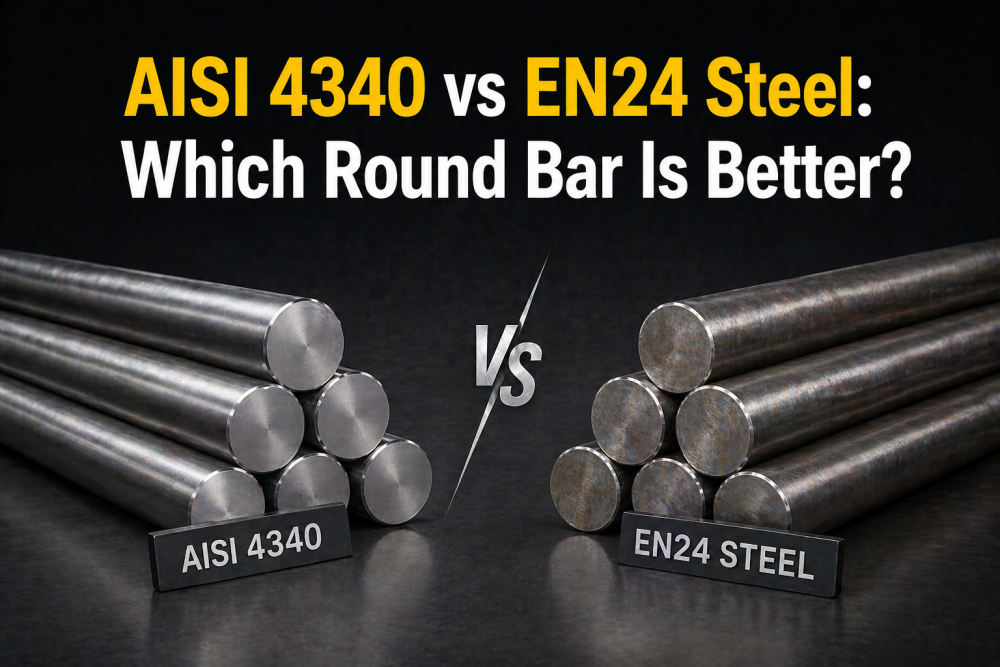
Selecting the proper material for heavy-duty engineering is crucial. AISI 4340 and EN24 are among the most widely used high-strength alloys. Both are reliable materials known for their reliability under stress. While they look similar, slight differences in chemistry change how they perform. Picking the wrong alloy can lead to failure of the part or higher costs. This guide looks at both steels to help you decide which round bar fits your project.
Overview of AISI 4340 Steel
AISI 4340 is a nickel-chromium-molybdenum alloy steel. It is known for its deep hardenability and high strength. Engineers use AISI 4340 round bars when they need a part that stays tough in large sections. It handles shock and impact very well. You will find it in aircraft landing gears, power transmission gears, and crankshafts. It maintains its properties even at high temperatures, making it a top choice for the aerospace sector.
Overview of EN24 Steel
EN24 is a high-grade alloy steel popular in the UK and Europe. It is equivalent to the 817M40 grade. This steel offers a great combination of tensile strength and ductility. It is usually supplied in the “T” condition, meaning it is already heat-treated. EN24 has good wear resistance and handles high-torque loads. It is a standard choice for drive shafts, axle beams, and heavy-duty bolts. Its versatility makes it a preferred choice in the general mechanical engineering industry.
AISI 4340 vs EN24: Key Differences
While both are alloy steels, their chemical composition and behaviour under heat differ slightly. Here is how they compare across various technical factors.
- Chemical composition comparison: AISI 4340 has more nickel than EN24. This extra nickel makes it tougher in cold conditions. EN24 has about the same amount of carbon, but it depends more on its mix of chromium and molybdenum to get its strength.
- Mechanical properties: Both steels can reach very high tensile strengths, over 1000 MPa. But at these high strengths, AISI 4340 is usually more ductile. It can bend a bit more before it breaks under very heavy loads.
- Heat treatment response: AISI 4340 has better through-hardening properties than EN24. If you have a very thick, round bar, 4340 will be hard all the way to the centre. EN24 might show a drop in hardness in the very middle of thick sections.
- Toughness and fatigue resistance: When comparing 4340 and EN24, 4340 handles fatigue better. It is more resistant to cracks when the part is stressed over and over again. EN24 is very tough but is often used where static strength is the main goal.
- Machinability: Both steels are tough to machine compared to mild steel. EN24 in its annealed state is slightly easier to work with. AISI 4340 needs special cutting tools and slower machining speeds to avoid wearing out the tools.
Performance Comparison in Real Applications
The choice between these two alloys depends on the environment where the part will work.
- Aerospace and defence: Weight and safety are very important in this industry. AISI 4340 is the preferred choice as it is very strong without being too heavy. It can handle the hard impacts of aircraft landings without cracking.
- Automotive components: For racing or heavy trucks, EN24 is a common choice for axles and shafts. It provides the torque resistance needed for high-power engines. It is often more cost-effective for these types of parts.
- Heavy machinery and shafts: Large industrial mixers or crushers need thick shafts. AISI 4340 is better here as it hardens deeply in large diameters. This makes the shaft strong all the way through.
- Industrial tooling: EN24 is often used for high-strength bolts and studs. It holds threads well and does not strip easily under tension. It is a reliable choice for the fasteners that hold big machines together.
Which One Should You Choose?
Selecting the right alloy steel depends on your specific performance needs and budget.
- When to choose AISI 4340: Choose EN24 for general engineering parts that must be strong but are not very thick. It is easier to find in local markets and can be cost-effective for standard parts.
- When EN24 is more suitable: Choose EN24 for general engineering parts that need high strength but are not as thick. It is often easier to find in local stocks and can be more affordable for standard parts.
- Application-based selection guide: Always check the diameter of your round bar first. For diameters over 150mm, 4340 is usually safer. For smaller, high-torque parts like gears, EN24 performs perfectly well.
Advantages and Limitations of Both Materials
Every material has a limitation. Understanding these helps you avoid unexpected issues during manufacturing.
- Strengths of AISI 4340: Its biggest strength is through-hardening and high fatigue limits. It stays strong even when subjected to millions of stress cycles.
- Strengths of EN24: EN24 is highly versatile and widely available in many pre-hardened states. It offers a great balance of wear resistance and toughness for most industrial jobs.
- Limitations and considerations: Both steels are prone to “hydrogen embrittlement” if not plated correctly. They also require careful pre-heating and post-heating if you plan to weld them.
Conclusion
Comparing AISI 4340 vs EN24 shows that both are excellent for high-stress environments. AISI 4340 is the premium choice for deep hardening and fatigue resistance. EN24 is a reliable, versatile option for standard high-strength engineering. Your choice should depend on the part thickness and the specific stresses it will face.
If you need high-performance materials for your next project, look for quality suppliers. You can find high-grade AISI 4340 UNS G43400 round bars to meet your exact industrial specifications. Choosing the right steel today prevents costly repairs tomorrow.