Introduction
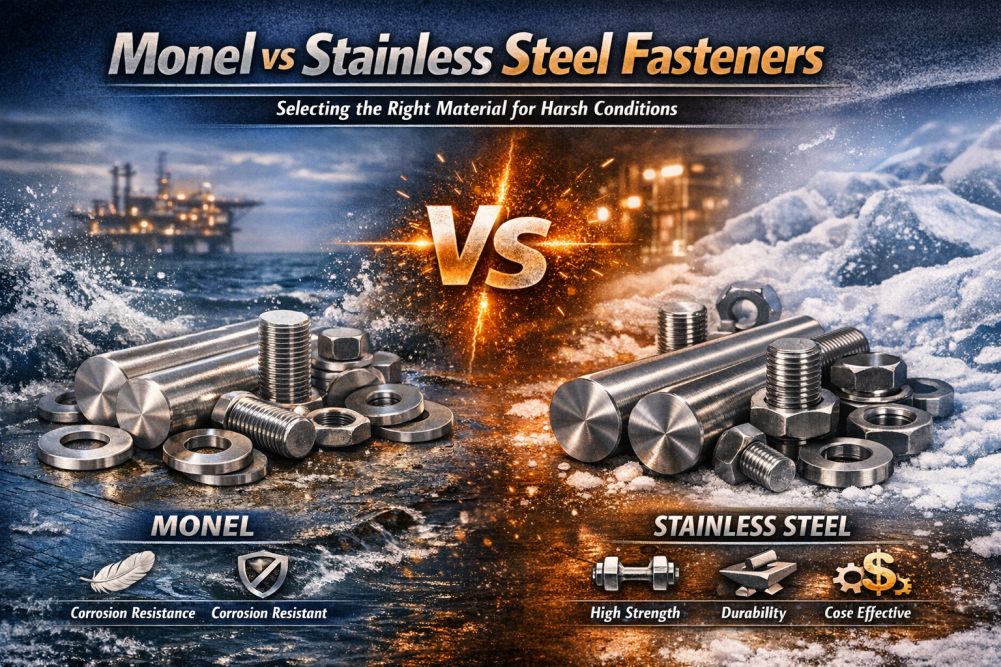
Monel vs stainless steel fasteners depend on corrosion exposure, temperature, and service life needs. Monel fasteners excel in seawater and aggressive chemical environments, while stainless steel fasteners suit many industrial applications requiring strength and corrosion resistance.
Choosing the right fastener material improves joint reliability, safety, and maintenance performance in harsh conditions. Marine systems, chemical plants, and high-moisture environments often favour Monel, while stainless steel remains a cost-effective choice for less severe corrosive service.
Overview of Monel Fasteners
Monel is a nickel-copper alloy with a high nickel content, which gives it exceptional corrosion resistance, particularly in environments that attack most other metals, including seawater, hydrofluoric acid, sulphuric acid, and alkaline solutions. Monel alloy fasteners maintain their mechanical strength across a wide temperature range and avoid stress corrosion cracking in chloride environments where stainless steel grades are vulnerable. Because of its durability in harsh conditions, the alloy is usually specified when the environment is the main design constraint and ordinary alloys fail.
Overview of Stainless Steel Fasteners
Stainless steel fasteners are the most widely specified corrosion-resistant fastening option across general industry. Grade 304 covers atmospheric and mildly corrosive environments effectively. Grade 316 adds molybdenum to improve resistance to chlorides and is the default specification for marine and chemical exposure in most engineering standards. Stainless steel is available in a broad range of sizes, forms, and thread standards, make them easy to procure. It performed well in moderate-to-demanding circumstances and meet most industrial fastening needs without the extra cost of specialist alloys.
Key Differences: Monel vs Stainless Steel Fasteners
Corrosion Resistance Comparison
Monel outperforms stainless steel in highly aggressive environments particularly those involving seawater at elevated temperatures, hydrofluoric acid, and reducing acid conditions where stainless steel’s passive layer breaks down. Stainless steel 316 performs well in moderate marine and chemical environments but shows limitations in concentrated chloride exposure and under crevice conditions where the passive oxide layer can’t maintain itself.
Mechanical Strength and Toughness
Both materials have good mechanical qualities that are suitable for structural fastening. Monel’s resistance to high temperatures makes it an attractive material for offshore and cryogenic applications.
Engineers who place a higher importance on mechanical performance than corrosion resistance choose stainless steel. Using this selected method, each fastener performs optimally in its chemical and heat environment. It ensures your hardware survives the specific environment you are building in.
Performance in Extreme vs Moderate Environments
Environment drives specification. The right choice is monel when the environment degrades stainless steel too quickly. Stainless steel handles moderate conditions well and should be the default if corrosion resistance is reasonable. Monel adds cost without commensurate advantage.
Cost Differences and Material Availability
Monel fasteners cost far more than stainless steel. Material availability is also reduced. Because fewer manufacturers produce Monel in lower volumes, lead times and minimum order quantities are affected. Conversely, you can easily source stainless steel fasteners worldwide, as they come in all conventional sizes and various thread types.
Corrosion Resistance in Harsh Environments
Monel outperforms stainless steel in aggressive environments like hydrofluoric acid, reducing acids, and hot seawater where passive layers break down. Stainless steel 316 performs well in moderate chemical or marine settings but fails during concentrated chloride exposure or under crevice conditions. In these spots, the passive oxide layer simply cannot maintain itself. Engineers choose Monel to ensure long-term durability when facing the toughest industrial or maritime corrosive challenges.
Mechanical Strength and Durability
Monel and stainless steel have high load-bearing capacity for various fasteners. Monel thrives in dynamic marine conditions due to its fatigue resistance, although stainless steel is still the norm for general structural purposes.
Significant mechanical variations appear primarily at severe temperatures or after extended corrosive exposure. Such extreme circumstances can erode fastener cross-sections; material selection is crucial for preserving long-term integrity in demanding installations.
Temperature and Environmental Performance
Monel is harder at low temperatures and stronger at high temperatures than standard stainless steel. In offshore environments subject to both thermal cycling and seawater exposure, that combination of properties justifies the material cost. Stainless steel takes high temperatures well in most industrial applications, although its oxidation resistance and mechanical retention degrade faster than Monel over specified thresholds. Cryogenic processing benefits from Monel’s low-temperature robustness.
Applications: Where Each Material is Preferred
Monel Fasteners
Marine and Offshore
Deck fittings, subsea connectors, and hull fastening in marine structures specify Monel for its resistance to continuous seawater exposure and its performance in submerged and splash-zone conditions where stainless steel corrodes at unacceptable rates.
Chemical Processing
Due to its corrosion resistance, Monel fasteners are used in flanged connections, valve bodies, and pressure vessel fastening in hydrofluoric acid, chlorinated solvents, and reducing acid systems.
Stainless Steel Fasteners
Construction
For moderate weather, buildings and civil infrastructure use stainless steel 316 for external structural fastening. Strength, corrosion resistance, and availability make it the standard.
General Engineering
Process equipment, machinery frames, and fabricated components in general industry use stainless steel fasteners when Monel isn’t suitable.
Food Processing
Hygienic equipment are used stainless steel for food-contact. Its smooth surface and cleaning equipment compatibility provide safe and compliant food and beverage manufacturing.
How to Choose Between Monel and Stainless Steel Fasteners
Environmental exposure is the first question. If the fastener will be in continuous contact with seawater, concentrated acids, or chloride-rich solutions that have caused stainless steel failures in similar applications, Monel is the appropriate material. If the environment is moderately corrosive and stainless steel has a proven track record in comparable service, the cost premium of Monel isn’t justified. Load and stress requirements rarely differentiate the two in standard applications, and materials handle typical fastening loads, so the decision is usually driven by corrosion, not mechanics.
Lifecycle and budget costs complete the analysis. Evaluate Monel’s higher unit cost against equipment damage, shutdown time, and corrosion-induced failure replacement labour. Even with a greater starting cost, lifespan arithmetic benefits Monel in hostile environments. This investment secures your project’s total operational ROI.
Conclusion
The choice between Monel fasteners and stainless steel fasteners is determined by a distinct set of engineering criteria: the environment’s severity, the acceptable maintenance interval, and the total lifecycle cost. Getting that evaluation right protects the assembly and the systems it holds together. For specific material grades, configurations, and application guidance, exploring the product range or contacting the supplier’s technical team directly is the practical next step.