Businesses need effective methods to create mobile applications that function properly on various platforms throughout today’s digital environment. This situation has resulted in hybrid mobile app development services becoming highly popular. Developers can create hybrid applications that use a single codebase to operate on both Android and iOS platforms. This development reduces costs while enabling faster product launches and creating easier systems to manage.
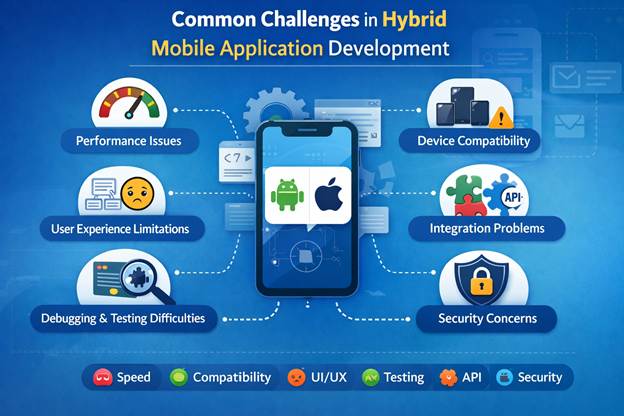
Hybrid development provides its advantages, but it also introduces different problems that need to be solved. The complexities that businesses fail to recognize will create problems that affect their app performance, user experience, and future growth. The development of successful applications requires organizations to understand these three challenges, which lead to their success.
The most frequent obstacles that organizations face during the development of hybrid mobile applications will be discussed together with effective solutions that businesses can implement to overcome these obstacles.
Performance Limitations Compared to Native Apps
The main problem that people debate about when developing hybrid apps is how well they perform. Hybrid apps use web technologies, which run inside native application frameworks, whereas native apps use platform-specific programming languages to create their applications for specific operating systems. The method results in decreased performance because the system needs to process multiple resource-intensive tasks, which include rendering animations and processing incoming data streams.
Hybrid frameworks present challenges to gaming applications and high-speed financial systems, which both require uninterrupted performance to function properly. The development of modern frameworks like React Native and Flutter has improved application performance, yet hybrid applications still fall short against native applications in some specific cases.
Solution:
Businesses need to assess their application needs before they begin their development process. The hybrid-native solution provides superior performance results for applications that require high-performance capabilities.
Inconsistent User Experience Across Platforms
User experience (UX) serves as a fundamental element that determines the success of every mobile application. The main issue with hybrid applications involves their inability to provide users with a seamless experience that works across multiple platforms.
The two operating systems, Android and iOS, follow different design standards, which include Material Design for Android and Human Interface Guidelines for iOS. The design of hybrid applications encounters difficulties because they need to meet two design standards, which results in either visual inconsistencies or an appearance that does not match users’ expectations.
Solution:
Providers who develop hybrid mobile applications possess expertise in developing platform-specific user interfaces, which they implement through a unified codebase system. The application achieves native platform performance through this method while development work continues at its regular pace.
Limited Access to Native Features
Hybrid applications depend on plugins and APIs to obtain access to device-specific functions, which include GPS, camera, Bluetooth, and sensors. The hybrid frameworks do not provide developers with access to all native functions because these functions require special optimization, which remains unavailable.
The unavailability of plugins, together with compatibility problems that affect specific device functions, creates obstacles that result in development delays for developers. The resulting situation restricts the capacity for innovation while it also restricting the abilities of the application.
Solution:
The development team needs to develop custom native modules that will enable them to connect missing functional elements. The development team needs to establish their framework selection process, which they will need to follow when choosing frameworks that have strong plugin ecosystems.
Dependency on Third-Party Plugins
The third-party plugins that hybrid app development uses for its core functionality require developers to use these external tools. The plugins that provide developers with simpler development solutions bring four security problems, which include:
- Compatibility issues that arise from fresh operating system upgrades
- The system does not receive any updates or maintenance
- The system has security weaknesses that need to be fixed
- The entire application will experience failure when a crucial plugin receives no further support or becomes obsolete.
Solution:
Businesses need to choose development partners who hold plugins in high regard as dependable tools that receive continuous support. The process of monitoring third-party dependencies requires organizations to implement regular updates together with active surveillance systems.
Debugging and Testing Complexity
Hybrid applications face greater debugging challenges because their system includes three different components which are web code, native wrappers, and plugins.
Identifying the root cause of an issue can be time-consuming, especially when bugs originate from cross-platform inconsistencies or third-party integrations. The process of testing devices requires additional work because testers must ensure the product functions well across different devices, screen sizes, and operating systems.
Solution:
The implementation of comprehensive testing methods that use both automated testing and real-device testing will decrease debugging difficulties. Hybrid mobile app development teams employ advanced testing software that helps them streamline their testing activities.
Security Concerns
Mobile application development must address security issues because all types of applications, including hybrid apps, need to meet security requirements. The hybrid applications, which depend on web technologies, face increased security risks that include:
- Cross-site scripting (XSS)
- Data leakage
- Insecure storage
The app becomes more vulnerable to security threats through improper plugin usage, which developers need to avoid.
Solution:
The solution to this problem requires developers to implement security best practices through data encryption, secure API integrations, and regular security audits. The implementation of secure coding standards with security frameworks enables developers to protect their systems from potential threats.
Scalability Challenges
Businesses need their applications to manage higher user loads and increased data processing and additional features when they experience growth. Hybrid applications encounter scalability problems when their initial system design fails to accommodate future expansion needs.
The app can only achieve limited growth because its performance problems and inefficient code structures act as growth constraints.
Solution:
The future development requires both a scalable architectural design and an optimized codebase, and complete cloud integration. The collaboration with experienced developers enables the team to implement scalable solutions throughout the development process, starting from the initial stages.
Integration with Complex Backend Systems
Modern applications need to connect with intricate backend systems, which include enterprise software, third-party APIs, and cloud platforms. Hybrid applications encounter difficulties when they need to manage these complex integrations with backend systems.
The application experiences operational problems because of its latency issues, data synchronization difficulties, and API restrictions.
Solution:
The combination of strong backend systems with microservices architecture and optimized APIs leads to better integration results. Hybrid mobile app development service providers who possess extensive industry experience deliver effective backend and frontend system communication solutions.
Maintenance and Updates
The situation becomes more complicated because hybrid apps need only one codebase for maintenance tasks, yet their multiple dependencies and plugins, as well as their specific platform requirements, create difficulties during the updating process. The ongoing release of operating system updates by Android and iOS has the potential to impact both application performance and system compatibility.
Solution:
The application needs regular maintenance combined with urgent updates and ongoing monitoring to maintain its operational efficiency. The development team works proactively to maintain the application’s compatibility with new technological advancements.
Choosing the Right Framework
The success of a hybrid application depends entirely on which framework developers select for their project. Developers face difficulty when they need to choose the best framework from the available options, which include React Native, Flutter, Ionic, and Xamarin. The distinct advantages and disadvantages of each framework define its respective technology ecosystem. When organizations select an inappropriate framework for their project needs, they encounter problems which include degraded performance, restricted growth capacity, and higher expenses for software development.
Solution:
Businesses should evaluate frameworks based on their project requirements, scalability needs, and long-term goals. Consulting experts in hybrid mobile app development services can help in making the right choice.
Balancing Cost and Quality
The main reason businesses choose hybrid development is to achieve lower development costs. The exclusive practice of cost reduction leads to degraded product quality and performance, and user experience deterioration.
The use of inexpensive development methods creates substandard applications that do not fulfill user requirements.
Solution:
Businesses need to shift their focus from cost reduction to understanding value. The recruitment of skilled developers establishes complete control over high-quality application development, which generates ongoing value for the company.
Final Thoughts
Businesses now create applications through hybrid mobile app development because it provides them with three essential benefits. The system presents several difficulties that need to be solved. The development of hybrid applications requires developers to implement planning procedures because the technology brings forth performance limits, security issues, and difficulties with system connections and problems of growth.
Development teams can find solutions to their existing problems by selecting appropriate development methods and working with experts who possess complete knowledge about hybrid technology.
Hybrid mobile app development services provide businesses with essential solutions that enable them to build applications that deliver high-performance results while remaining scalable and easy to use. Businesses that want to establish their digital presence through hybrid apps need to understand two essential requirements that need to be managed through appropriate expert solutions and proper handling methods.