Introduction
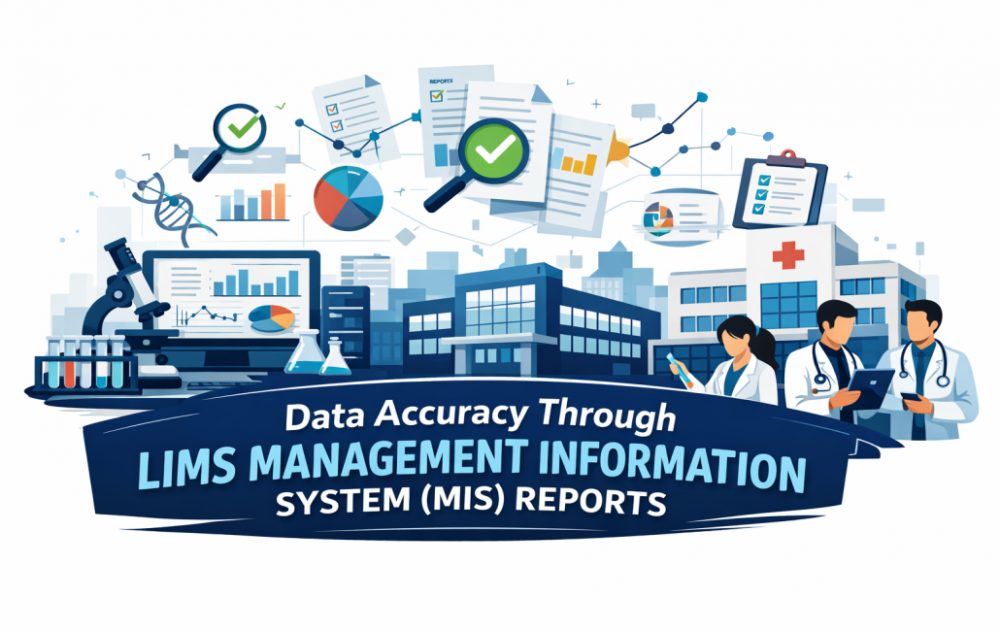
With the modern healthcare setting that is built upon data, accuracy and reliability play a crucial role in the success of the laboratory. Laboratory information management system guarantees accurate management of laboratory data besides enhancing transparency in the operations. The Laboratory Information Management System enables Labs to remove errors, improve compliance, and streamline workflows through highly developed MIS reporting. Laboratories with Laboratory Billing Software have full control of clinical, financial, and operational performance when used with Pathology Lab Software. Learning about the role of LIMS in the healthcare field is a key to the attainment of uniform data quality throughout the contemporary lab ecosystem.
Reliable Data Accuracy in LIMS MIS Reports
The accuracy of data consisting of MIS reports is the foundation of the effective and trustworthy laboratory procedures. LIMS is a real-time Laboratory Information Management System that captures, validates, processes, and organizes laboratory data which minimizes human dependency and operational risk. This is because MIS reports produced by a lab management information system enable the decision-makers to track the lifecycles of samples, test result, billing status, quality measures and regulatory compliance indicators without difference and delays.
The Laboratory Information Management System is closely coupled with both Laboratory Billing Software and Pathology Lab Software in that the clinical and financial information is in tandem across the departments. This integration is a clear indication of the role of LIMS in the healthcare sector in terms of eradicating data silos, lessening the intervention, and ensuring confidence in the reported outcomes. A strong LIMS laboratory information management system standardizes the reporting formats, reduces redundancy of information, increases traceability, and end-to-end visibility in all the laboratory operations.
Their Use for Accurate Laboratory Information Management System Data
The Role of LIMS in Healthcare with MIS Report
The manner in which LIMS have a role in healthcare is directly related to the flow of data in the laboratory processes. A Laboratory Information Management System is an automated system that captures data recorded by laboratory instruments, analyzers and diagnostic devices and this has greatly reduced the number of transcription errors and entry errors. The lab management information system will confirm that the set of rules are satisfied by each piece of data before it can be shown in MIS dashboards, and this makes it consistent and reliable.
To facilitate proper reporting a Laboratory Information Management System aids in:
- Synchronization of data entry and nomenclature between the departments.
- Matching Laboratory Billing Software and with test orders and results.
- Matching Pathology Lab Software outputs to patient histories and clinician inputs.
- Imposing validation before finalisation of data in MIS reports.
These strengths can prove the advantages of adopting a laboratory information management system by healthcare organizations that prioritize accuracy, responsibility, and evidence-based healthcare decision-making.
Accuracy of MIS Reports as the Heart of Lab Management Information System
The actionable information on the laboratory efficiency, productivity, and quality is provided by MIS reports that a Laboratory Information Manager System generates. These reports assist the administrators and managers to see the bottlenecks in their operations, track the turnaround time, reagent utilization and billing accuracy with built-in Laboratory Billing Software.
A laboratory management information system facilitates:
- Proper workload analysis and test volume.
- Laboratory Billing Software- Revenue reconcile and audit ready.
- Pathology Lab Software Quality control and performance monitoring.
- Long-term planning and capacity optimization Trend analysis Trend analysis.
Through strengthening the roles of LIMS in the field of healthcare, MIS reports can be regarded as key to regulatory compliance, accreditation preparedness, and consistent improvement of operations.
Laboratory Billing Software Integration to be Financially Accurate
A Laboratory Information Management System, which is also a Laboratory Billing Software, guarantees a high level of accuracy in end-to-end financial data. Test orders, pricing, insurance, and discounts, and payments are linked seamlessly in real-time in MIS reports. This close interface in the lab management information system minimizes claim refusals, billing discrepancies, and revenue loss.
Laboratory Information Management System confirms the billing information prior to submission, which once again confirms that LIMS have a role to play in healthcare by ensuring integrity of revenue and financial transparency. In combination with Pathology Lab Software, both diagnostic and financial data are kept in line, allowing reimbursements to be more timely and patient trust is enhanced.
Pathology Lab Software and Diagnostic Data Integrity
This is because proper diagnostics depend on a smooth integration between Pathology Lab Software, as well as the Laboratory Information Management System. The production of MIS reports by the LIMS laboratory information management system offers real time access to the workflows of pathology, starting with the accessioning of samples to the writing of result authorization.
A single lab management information system will guarantee:
- Standard and error-free pathology reporting.
- Traceability of samples, reagents and results.
- Coherence and reliability of all MIS reports.
- Greater confidence in clinical results by clinicians.
This emphasizes the role of LIMS in healthcare to ensure diagnostic reliability, better patient safety, and clinical decision-making.
Advantages of Laboratory Information Management System on Accuracy of the Data
The advantages of the adoption of laboratory information management systems are far reaching past the basic automation and data storage. A Laboratory Information Management System (LIMS) enhances data control through standardization of the workflows, reduction of manual rule, and consistency in the entire laboratories operations. Laboratories can ensure total data integrity and transparency by using high-level role-based access control, the detailed audit trails, intelligent validation rules, and standardized MIS reporting frameworks.
Laboratory Billing Software and Pathology lab software are run on a single, unified source of truth because of MIS reports created through a lab management information system. Such a centralized data environment will remove data silos, minimize reporting anomalies, and improve interdepartmental cooperation. Consequently, the laboratories obtain enhanced control of the accuracy of operations, financial stability, and compliance with regulations.
A Laboratory Information Management System Enhances Accuracy of Data Because It Facilitates:
- Role based access control to avoid unauthorized data alteration.
- Robotic validation of data to minimize human and transcription errors.
- Traceable and compliance ready audit trails.
- Unified MIS reports to provide uniform and dependable decisions.
- No billing errors because of seamless integration with Laboratory Billing Software.
- Integrity of diagnostic data with Pathology Lab Software.
- Unified data management which takes advantage of scalability and future expansion.
All these abilities just prove that LIMS are a valuable strategic tool in healthcare. A laboratory information management system provides laboratories with the power to attain long-term accuracy, regulatory compliance, operational excellence, and long-term trust in healthcare reporting by providing accurate, secure, and standardized data in both clinical and financial processes.
Conclusion
In contemporary laboratories, data accuracy is no longer a choice. MIS-backed Laboratory Information Management System yields dependable, stable, and operative information. Pathology Laboratories are able to develop the clarity of operations and financial precision by integrating the Laboratory Billing Software, the pathology lab software and centralized lab management information system. Knowing the impact of LIMS in healthcare, it is important to understand that it is important in improving the trust, compliance, and patient outcomes. The long-term advantages of using a laboratory information management system are that it will ensure accuracy is maintained sustainably and provide smarter decision making.