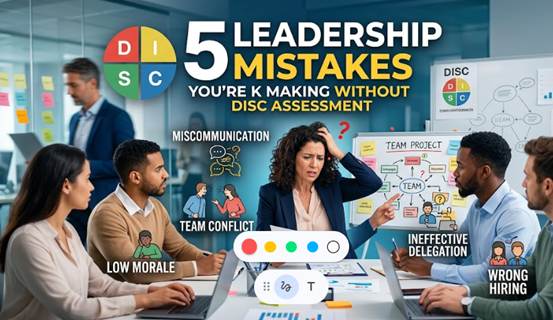
The concept of good leadership goes beyond authority and decision-making; it involves understanding the people involved. Many leaders fail to relate to their teams without even knowing why. This is where disc assessment leadership comes into play. Without knowing one’s behavior style, they may find themselves making decisions that cause misalignment and poor performance of the team.
Here are five common leadership blunders and how to correct them.
Blunder Number 1: One-Size-Fits-All Leadership Style
Leadership mistakes start with assuming all members of a group are equal. Consistency is necessary but not all people have been made the same way.
While there are those who excel under a directive and task-oriented leader, there are also those who require motivation and security. Leaders tend to lead based on their behavior style without thinking twice.
How This Goes Wrong
● Communication barriers arise
● Decreases motivation in some personality types
● Causes misunderstandings and frustration
How To Fix It
Using DISC, leaders can understand various behavioral traits:
● Decisive people need fast and purposeful communication
● Interactive people react to energy and acknowledgement
● Supporting team members appreciate backing and stability
● Deliberate people require clarification and information
By modifying their style, you will create a more diverse workplace.
Mistake 2: Misunderstanding Team Members’ Behavior
Not having knowledge about different behavioral types, leaders often interpret behaviors inaccurately.
For instance:
● A straightforward communicator is perceived as rude
● A quiet employee is seen as a detached individual
● A careful team member is considered slow
These interpretations cause damage to relationships within the team.
How This Goes Wrong
● Results in wrong perceptions
● Increases conflicts unnecessarily
● Damages the team’s unity
How To Fix It
By using DISC, leaders can understand the reasons behind behaviors. Rather than assuming, they start seeing things for what they are.
Mistake #3: Bad Communication That Isn’t Persuasive
Communication is crucial in leadership, but many leaders communicate in ways that only benefit their style of working.
Some examples are:
● A quick-moving leader might confuse his slow-working colleague
● An elaborate communication will irritate someone who prefers simple and to-the-point discussions
Why It Fails?
● It does not get across what was intended
● The message is misunderstood and overlooked
● It reduces productivity and efficiency
The Solution
Leaders can learn from DISC assessment to customize their communication styles:
● Results-focused individuals need a brief and straightforward approach
● Communicate using encouraging and cooperative language for social personalities
● Social individuals need assurance and guidance in order to be productive
● Use logical arguments and factual data for analytical personalities
This makes communication styles highly effective and persuasive.
Mistake #4: Disregarding Dynamics of Working Together
Not only individual personalities matter in leadership, but also teamwork plays an important role in it. Without DISC, many leaders do not pay attention to the dynamics of different personalities.
Examples of this problem are:
● One dominating personality might overshadow other individuals
● Socially active individuals might create conflicts among themselves and with other people
Reason Why This Mistake Happens
●Causes Imbalance Within the Team
●Restricts Collaboration
●Causes Unresolved Tensions
Solution With DISC
The DISC framework allows leaders to create a well-balanced team by:
● Acknowledging strengths and weaknesses
● Encouraging appreciation of diversity
● Giving each team member roles that match their strengths
Mistake #5: Ineffective Personal Development Strategies
Employee development remains one of the major concerns among many leaders. They tend to use a universal strategy when developing their employees.
Yet, some people respond to different motivational factors:
● Some need challenges and immediate results
● Some enjoy stability and gradual improvement
● Some appreciate recognition, while others enjoy precision and control
Reason Why This Mistake Happens
● Employees feel not understood by their superiors
● Development programs do not have the desired effect
● High-potential employees might become disengaged from their tasks
Solution With DISC
Using DISC insights, leaders can offer personalized development solutions:
● Give decision-making experience to dominant personalities
● Provide visibility and recognition to influential personalities
● Help stabilize employees
● Challenge careful personalities with analytical tasks
The True Cost of DISC Neglect in Leadership
When leaders fail to apply behavioral knowledge, the results are more than just poor communication. Companies will suffer from:
● Higher staff turnover
● Lower levels of engagement
● Poor collaboration
● Failure to achieve performance objectives
The problem lies in the absence of knowledge, rather than incompetence.
How to Incorporate DISC Into Your Leadership
It’s possible to adopt DISC into your leadership style without making significant changes. Consider these strategies:
1. Recognize Your Behavior
Self-awareness is key to becoming an efficient leader. Discover your behavioral preferences according to DISC and learn how to make decisions based on them.
2. Get to Know Your Staff
Motivate your employees to study their DISC tendencies. This will help you establish a common language of communication.
3. Modify Your Approach
Make minor changes in your communication and delegation styles.
4. Consistency Is Key
DISC shouldn’t be a one-off exercise. Utilize it regularly during meetings and performance reviews.
Conclusion
To be a leader does not require changing one’s own personality; it requires broadening one’s style of leading. Without DISC evaluation, seasoned leaders may easily get stuck in habits that undermine their performance. When leaders become knowledgeable about behavioral tendencies and respond effectively, they can avoid pitfalls and foster positive connections. In an environment where people are considered the company’s most valuable resource, the need for interpersonal insight is more crucial than ever.