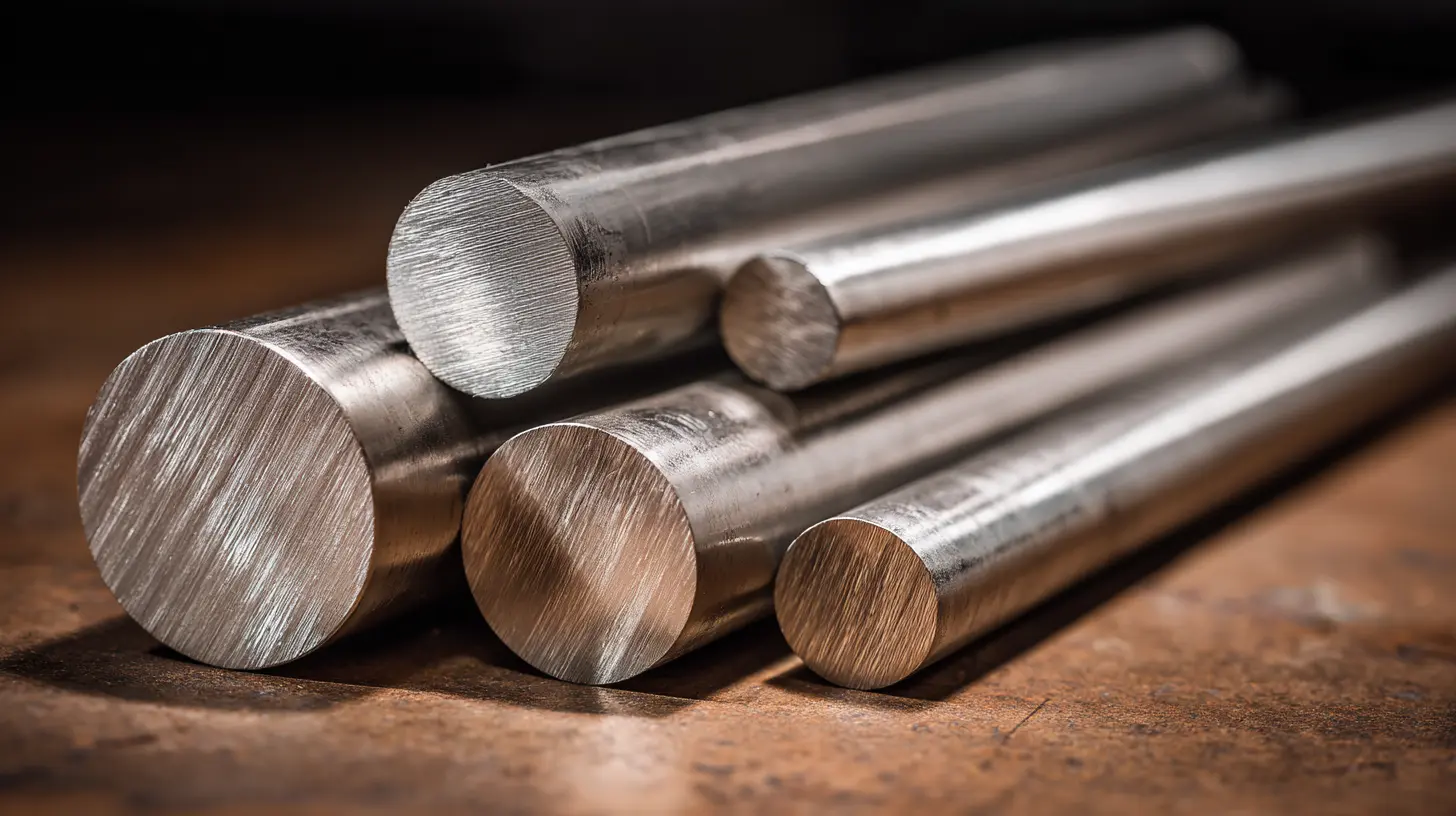
Aircraft engines operate at temperatures above 500°C. Ship hulls sit in seawater for decades without dry dock access. Materials in both settings carry heavy structural loads while resisting fatigue, corrosion, and thermal stress at the same time, and few metals meet all three demands together. Titanium bars do, combining a strength-to-weight ratio close to steel with corrosion resistance that rivals stainless alloys, at roughly 40% less weight. This combination has pushed titanium into landing gear, turbine components, propeller shafts, and offshore platform fittings. Procurement teams sourcing industrial titanium bars for critical builds now treat the material as a baseline requirement, not an upgrade.
What Are Titanium Bars?
Titanium bars are solid metal bars made from titanium and alloying elements with the composition of the bar, most often alloyed with aluminum and vanadium in the Grade 5 (Ti-6Al-4V) composition. Pure titanium grades (grades 1–4) have a higher ductility but lower strength compared to alloyed grades, which have some of the mechanical properties sacrificed in order to achieve greater formability. The most common type is a round bar of titanium. It can be forged, rolled, or extruded, and then heat treated to improve grain structure. Titanium metal bars can also be square, hex, or flat as per the application. Manufacturing is done to standards like ASTM B348 and AMS 4928, which limit tensile strength, elongation, and chemical composition for aerospace and marine procurement.
Why Titanium Is the Preferred Material for Aerospace and Marine Industries
When operating conditions are extreme, there is a need for materials that will retain their structural integrity under load, heat, and continuous exposure to corrosive elements, and titanium delivers on all three.
Lightweight Construction
Titanium is stronger than steel but about 40% lighter; therefore, it is used in aircraft to decrease fuel consumption and in ships to decrease the weight of the hull while still getting a comparable amount of load.
High Structural Strength
Grade 5 titanium has a tensile strength of greater than 900 MPa, allowing engineers to use thinner sections in landing gear and hull fittings without compromising load capacity.
Corrosion Resistance
A stable oxide layer forms on titanium surfaces on contact with air or water. This layer resists pitting from saltwater and chlorides far longer than untreated steel.
Long Operational Life
Titanium components often outlast the equipment they support. Decades-old aircraft frames and offshore platform parts made from titanium still perform in original condition.
Reduced Maintenance
Corrosion and fatigue resistance together mean fewer inspection cycles and less part replacement across the working life of the equipment, particularly in fastener stock.
Excellent Fatigue Resistance
Titanium bars tolerate repeated stress cycles without the crack propagation common in aluminum, which matters most under the constant vibration found in aircraft structures.
Reliability in Harsh Environments
Deep-sea pressure, engine heat, and salt spray all degrade standard metals over time. Titanium holds its mechanical properties across this range under sustained exposure.
Key Benefits of Titanium Bars
In addition to baseline requirements, titanium bars provide measurable engineering benefits in weight, strength, temperature tolerance, and life cycle cost.
Exceptional Strength-to-Weight Ratio
Titanium bars offer outstanding mechanical properties while maintaining a low density to provide a reduction in structural weight without compromising load capacity. This helps to make aircraft more fuel-efficient and reduces the capacity demands on marine support structures.
Outstanding Corrosion Resistance
Titanium is the most resistant of the structural metals to saltwater and chloride exposure and is commonly used for seawater piping, propeller shafts, and offshore fittings subject to continuous exposure to saltwater.
High Temperature Performance
Titanium alloy bars stay mechanically stable at elevated temperatures where aluminum alloys soften, which is why jet engine compressor sections depend on this heat resistance.
Excellent Fatigue and Crack Resistance
Fatigue cracking is a problem that occurs over time with weaker metals under repeated loading cycles in either flight or at sea. Titanium bars are crack- initiation resistant, which helps long-term structural reliability.
Long Lifespan
Corrosion rates and fatigue resistance are lower than standard metals, meaning the life of the component is significantly greater, reducing the number of times it has to be replaced and reducing lifecycle costs.
Applications of Titanium Bars in the Aerospace Industry
The aerospace manufacturers rely on titanium bars across structural, propulsion, and fastening systems where weight and reliability both matter.
Aircraft Structural Components
Fuselage frames and wing spars use titanium bars where load paths concentrate, without adding structural weight.
Landing Gear Components
Landing gear struts and pins take repeated shock loading on every landing, which is why fatigue resistance matters here.
Jet Engine Parts
Compressor discs, shafts, and casings inside jet engines use titanium bars for stability at operating temperature.
Turbine Blades
Certain turbine blade roots and compressor blades use titanium alloys, balancing heat resistance with low rotating mass.
Fasteners
Titanium bolts and fasteners hold airframe sections together without the weight penalty of steel hardware.
Hydraulic Systems
Hydraulic system components benefit from titanium’s corrosion resistance in lines under pressure and temperature cycling.
Aerospace Frames
Bulkheads and support frames use titanium bar stock machined into precise structural shapes.
Spacecraft Components
Spacecraft structural elements use titanium for strength at low weight and resistance to thermal cycling.
Applications of Titanium Bars in the Marine Industry
Marine engineering applications depend on titanium bars wherever constant saltwater exposure would otherwise shorten the service life of standard metals.
Shipbuilding
Shipbuilders use titanium bars in hull fittings exposed to continuous seawater contact.
Offshore Platforms
Offshore platform fittings use titanium to resist decades of salt spray and wave loading.
Heat Exchangers
Heat exchanger tubes use titanium bar stock for resistance to seawater corrosion.
Propeller Shafts
Propeller shafts machined from titanium resist pitting corrosion under continuous rotational load.
Marine Fasteners
Marine fasteners made from titanium hold joints together without corroding over years at sea.
Desalination Plants
Desalination plant piping uses titanium for resistance to concentrated brine and chloride exposure.
Seawater Piping Systems
Seawater piping fittings machined from titanium bars handle constant flow without scaling or pitting.
Subsea Equipment
Subsea equipment housings use titanium bars for pressure resistance at depth with corrosion protection.
Pumps and Valves
Pumps and valves handling seawater use titanium where standard metals need frequent replacement.
Factors to Consider When Selecting Titanium Alloy Bars
Selecting titanium alloy bars for critical builds depends on more than material availability, and engineers weigh several technical factors before specifying grade and size.
- The grade classification determines the balance relationship between strength, ductility, and weldability of the component.
- The mechanical properties, e.g., tensile strength and elongation, should be appropriate for the loads to which the part is subjected.
- Which grade will withstand corrosion best will depend on the environment, whether it is saltwater, brine, or industrial.
- The grade selection may also be affected by the operating temperature range because some alloys become weak when exposed to steady high temperatures.
- Some industry specifications, such as ASTM and AMS, establish minimum standards for aerospace and marine procurement.
- The size and dimensions of the barstock should fit the part being turned and should not be greater than necessary.
- The machinability will differ among grades and relate to tool wear, cycle time, and total production costs.
- The final grade and size decision is made based on application requirements such as certification requirements and safety margins.
Why Titanium Round Bars Are Ideal for Critical Engineering Applications
Titanium round bars are machined to precise tolerances, which are used in precision parts for safety applications and to maintain dimensional stability during repeated cutting, turning, and threading processes. This consistency is important when it comes to landing gear pins, propeller shafts, and fastener stock, where slight dimensional drift can impact fit and function. When bar stock is manufactured to tight mill tolerances, there is less variation between each production batch; therefore, there is repeatable quality for large orders. Titanium round bars are capable of maintaining mechanical properties under combined load, heat, and corrosive exposure without progressive loss of properties as occurs with conventional alloys. This reliability makes titanium round bars a choice in components where failure is not an option, for both aerospace and marine applications.
Conclusion
Titanium bars solve a problem few other materials can, carrying aerospace and marine structures through decades of heat, load, and saltwater exposure without the weight penalty of steel. Their strength-to-weight ratio, corrosion resistance, and fatigue performance explain why they now appear across landing gear, turbine components, hull fittings, and subsea equipment. Titanium Alloy Bars and Titanium Round Bars give engineers material options suited to nearly every critical application, from aircraft frames to offshore platforms. Metra Core Alloys supplies titanium bar stock across grades and sizes for aerospace and marine engineering projects. For procurement teams and design engineers, titanium remains a specification built on measurable performance, not preference.