Ports have always been the pressure valves of global commerce. When they work well, goods move, supply chains stay balanced, and trade flows without friction. When they don’t, as the world saw during COVID-era disruptions, the damage cascades across every industry.
What’s different now is the scale of the problem. Global container traffic is expected to exceed one billion containers by 2030. Ships are getting larger. Trade routes are shifting. And most port infrastructure was never designed to absorb that kind of volume without breaking down.
Smart port technology isn’t a concept being discussed in strategy sessions anymore. It’s an active investment priority for governments and port operators across Asia-Pacific, Europe, and North America, driven by hard commercial reality rather than digital enthusiasm.
What Is Smart Port Technology and Why the Definition Matters Now
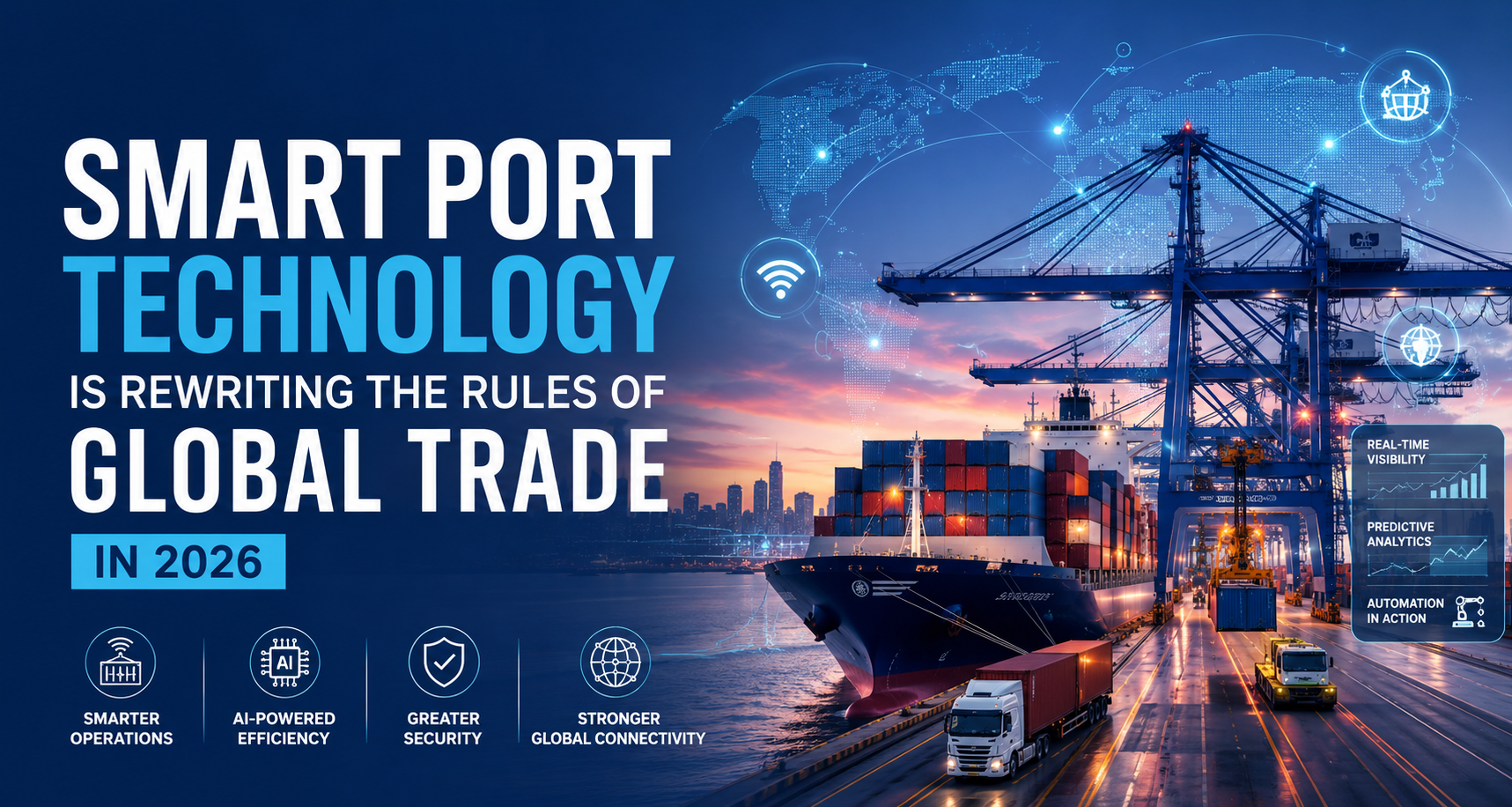
A smart port is a maritime terminal that uses interconnected digital systems, including IoT sensors, AI platforms, automation equipment, Terminal Operations Software, and data analytics to manage vessel traffic, cargo movement, equipment health, and operational decisions in real time.
That definition is deliberately broad. And that’s the point.
What separates a smart port from a port that simply uses software is integration. A port management software platform handling berth scheduling in one silo, while a separate system tracks cargo and a third monitors equipment, isn’t smart operations. That’s digitized fragmentation.
The ports that are genuinely ahead have moved past point solutions. They’ve built connected data environments where vessel arrival predictions inform berth allocation, which triggers yard planning, which coordinates gate operations and equipment dispatch, all with minimal human hand-offs.
That integration is exactly what the market is rewarding. The global smart port market was valued at $1.6 billion in 2025 and is projected to reach $7.3 billion by 2032, growing at a compound annual rate of 23.6%. That isn’t speculative growth. Much of this investment is being directed toward Automation in Ports, enabling terminals to increase throughput, reduce delays, and improve operational visibility across the supply chain.
The Pressure Points Traditional Ports Can No Longer Ignore
Vessel Sizes Have Outgrown Port Infrastructure
Modern ultra-large container vessels carry over 24,000 TEUs. Designed to maximize per-unit shipping economics, these ships create a specific problem: when they berth, they generate enormous bursts of activity that conventional manual operations simply can’t absorb at speed.
A traditional terminal brings in supervisors, radio-coordinates crane operators, manually logs cargo positions, and manages truck gate queues through a combination of experience and improvisation. That system can process perhaps 30 moves per crane hour under ideal conditions.
Automated terminals, by contrast, can sustain 40 to 50 or more moves per crane hour with significantly greater consistency. And they do it without degrading performance over a 12-hour shift. These performance gains are largely driven by Container Terminal Automation strategies that integrate equipment, workforce planning, and operational data into a unified ecosystem.
Manual Operations Are a Supply Chain Liability
The shipping industry loses roughly $50 billion annually to port waiting times and operational delays. These aren’t anomalies. They’re systemic outputs of manual, disconnected processes that create uncertainty at every handoff point.
For supply chain executives, a delayed vessel departure isn’t just a maritime inconvenience. It shifts production schedules, pushes back inventory replenishment windows, disrupts retail distribution, and creates a ripple effect that touches manufacturers, logistics providers, and end consumers.
The World Bank’s Container Port Performance Index tracks dwell times and turnaround efficiency across 405 ports globally. What the data consistently shows is that the performance gap between leading and lagging ports has widened, and the differentiator is technology adoption.
What Terminal Automation Systems Actually Deliver on the Ground
Terminal automation systems cover a broad spectrum, supporting Automated Container Handling through technologies such as automated stacking cranes (ASCs), automated guided vehicles (AGVs), OCR gate systems, and AI-powered planning engines.
Here’s what the implementation data actually shows:
| Automation Component | Primary Operational Impact |
| Automated Stacking Cranes (ASC) | 30 to 40% increase in yard density utilization |
| Automated Guided Vehicles (AGV) | Consistent inter-terminal transport with near-zero incidents |
| OCR Gate Systems | Gate processing times reduced from 3 to 5 minutes to under 60 seconds |
| AI-Powered Berth Planning | Vessel turnaround times reduced by 15 to 25% |
| Predictive Maintenance Platforms | Unplanned equipment downtime reduced by up to 20% |
The important caveat: these results come from terminals where automation was implemented as a planned, phased program, not where equipment was installed without corresponding process and systems redesign.
What the Supply Chain Gains When Ports Go Smart
The benefits of port digital transformation extend well beyond the terminal fence. Supply chains that rely on ports as throughput nodes gain measurable advantages when those ports operate with greater predictability.
Improved schedule reliability. An effective Automated Shipping System helps synchronize vessel schedules, cargo movement, and terminal resources, reducing uncertainty throughout the logistics chain. Vessel ETAs, berth availability, and departure confirmations all become more accurate when port operations are data-driven. That accuracy allows logistics providers and shippers to make better decisions earlier in the transport chain.
Reduced inventory buffers. Supply chain teams maintain safety stock partially to absorb uncertainty at ports. When port performance becomes more consistent, the justification for carrying excess inventory weakens. The working capital implication is significant at scale.
Better cross-border trade velocity. Ports that have integrated their digital operations with customs platforms and freight forwarder systems reduce documentation processing times substantially. Blockchain-based trade documentation is now live in several major ports and is demonstrating real reductions in clearance delays.
Sustainability performance. Port digital operations directly reduce idle vessel time, empty equipment movements, and energy waste. This matters both for environmental compliance and for the growing number of shippers with supply chain emissions commitments.
Where Enterprise Leaders Should Focus Their Investment
Port operators and supply chain executives approaching this space should resist the temptation to start with the most visible technology. Autonomous cranes or digital twins attract attention, but they’re outputs of a well-designed digital infrastructure, not the starting point.
The foundation that needs to be in place first:
1. Data architecture and integration. Audit what systems currently exist and how they share data. If the answer is “they don’t, really,” that’s the first problem to solve. No automation or AI layer performs well on fragmented data.
2. Connectivity infrastructure. Private 5G or high-reliability wireless networks are the physical backbone of automation in ports. This is an infrastructure investment that precedes equipment deployment.
3. Cybersecurity framework. Build the security architecture before deploying connected systems, not after. Retrofitting security into an already-live OT environment is significantly more expensive and disruptive.
4. Phased automation roadmap. Define which operational areas deliver the highest ROI from automation first. Gate operations and yard management typically offer faster payback than quayside automation. Start there, demonstrate results, then expand.
5. Workforce transition plan. Define the new roles that automation creates, including remote operation, data analysis, and system maintenance, and begin building those skills inside the organization before the technology arrives.
Ports that sequence these correctly see significantly better outcomes than those that lead with equipment procurement.
Conclusion
Smart port technology is no longer a future investment. It is the operational baseline that competitive terminals are building on right now. At INTECH Creative Services, we partner with port authorities and terminal operators to design and deliver the full technology stack, from AI-powered planning and real-time monitoring to managed services and enterprise architecture. If your terminal is ready to close the gap between where it operates today and where global trade demands it performs tomorrow, our team is ready to help.