Running a busy industrial site in Melbourne is hard work. Dodging forklifts shouldn’t be part of the daily grind. Did you know something as basic as painting the floor properly can slash vehicle and pedestrian accidents by a whopping 60%? It’s true. But we’re not talking about a quick trip to the hardware store for a tin of yellow paint.
When done right, line marking becomes a massive visual communication tool. It guides your traffic, enforces boundaries, and keeps the workplace safe.
Playing by the Rules
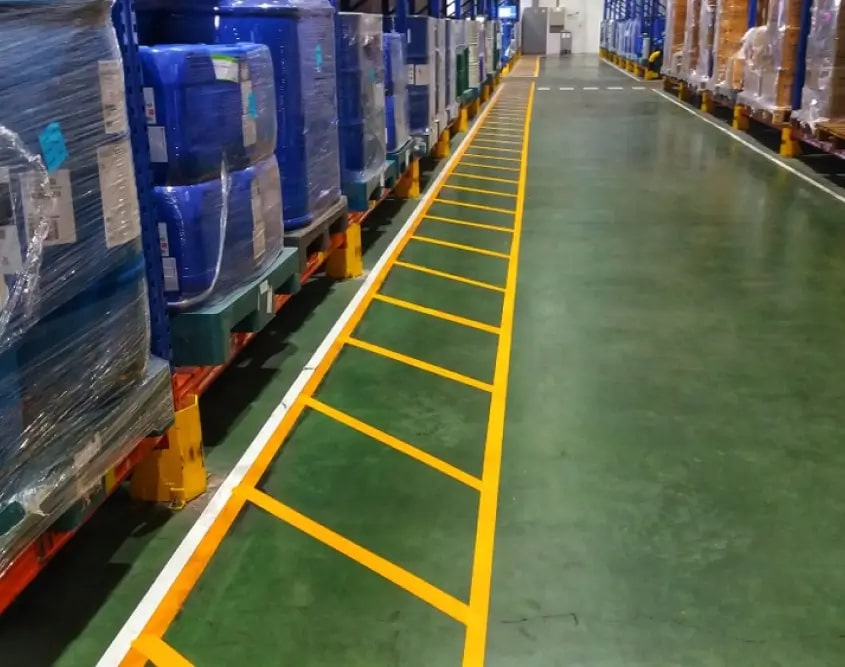
If you want a safe warehouse, playing by the rules is your bedrock. National standards aren’t just red tape; they actually work. Take the AS 1319 colour coding system, for example. It uses specific colours to give your crew instant visual cues. Yellow screams “pedestrian walkway” or “caution”, red points straight to fire equipment, and green highlights your emergency exits.
Then you’ve got structural standards like AS 1742.2 for managing internal traffic and AS 4084 for safe racking access. The specs are pretty black and white. Single-direction walkways need to be at least 1000mm wide, while two-way traffic needs 1800mm.
Skipping these guidelines? Expect big trouble. So pay close attention – every line must sit right where it belongs. Markings stay sharp, never washing out. Edges hold firm, never smudging into haze. That’s exactly why keeping on top of line marking in Melbourne is a non-negotiable for local businesses.
Sorting the Chaos with 5S
When it comes to workplace safety, especially in warehouses, we always correlate that space with a well-organised one. Enter the 5S methodology: Sort, Set in Order, Shine, Standardise, and Sustain.
Picture this: floor lines quietly running the show during cleanup. Workers spend less time hunting down lost items when every piece of equipment has its spot called out loud on the ground. Bright zones for supplies, waste cans, and tool racks – each one snaps into place because the path is clear. Stuff just ends up where it should.
Plus, it keeps everyone honest. Bright lines act as daily nudges for your team to follow the rules, taking the guesswork out of the equation and keeping your workflow humming along.
The Hidden Trap: Slip Resistance
Here’s a detail facility managers often miss: the grip of your lines matters just as much as their brightness.
The AS 4586 standard uses a “Wet Pendulum Test” to measure slip resistance, giving the surface a ‘P Rating’ for pedestrian safety. A standard coat of waterborne paint often scores a P1, which is dangerously slippery the second it gets wet. Imagine a forklift driver walking on a painted area that is still wet from the overnight cleaning. Without proper grip, it is almost certain to lead to an accident.
For commercial walkways, you absolutely need a minimum P4 rating. If the floor is outdoors or scrubbed daily, you should be pushing for a P5. To hit these targets, experts mix anti-slip aggregates into epoxy or lay down textured thermoplastics. This is exactly why professional line marking matters; a DIY job simply won’t pass these crucial safety tests.
Matching Materials to Melbourne
One moment it rains, next thing sunshine – Melbourne does that often. So picking stuff right means matching what the air actually brings each day.
Indoors, two-pack epoxy rules the roost. It chemically bonds to the concrete and resists chemical spills. Outdoors? Thermoplastic is your best mate. It’s incredibly UV stable and handles our harsh sun without breaking a sweat.
And when winter rolls around, and the temperature absolutely plummets, standard epoxy won’t cure. Contractors have to bust out specialised low-temperature formulations that can set securely even down to -5°C.
Your industry also dictates the materials. In food factories, floors face relentless cleaning every day, so a thick epoxy that blocks chemicals and germs becomes essential.
Wrapping It Up:
At the end of the day, it’s not just about splashing some yellow paint on the ground.Accurate line marking is a highly engineered safety solution. It keeps heavy forklifts away from your staff, stops nasty slips, and keeps operations running smoothly as silk. To avoid the massive headaches of rework and liability claims, facility managers should bite the bullet and bring in Marking Specialists Melbourne. You need someone who truly understands AS standards, proper surface prep, and the exact right materials for the gig.