The world has transformed in the last two years beyond people’s beliefs. If you walk into a high school or a middle school, students only don’t talk about video games or social media; they also talk about things like Chat GPT, AI-created art, and technology as it is something that gets more clever day by day. Recently Apple launched the Apple Intelligence, followed by the evolution of Open AI, so Artificial Intelligence and Machine Learning have evolved from futuristic ideas into everyday reality.
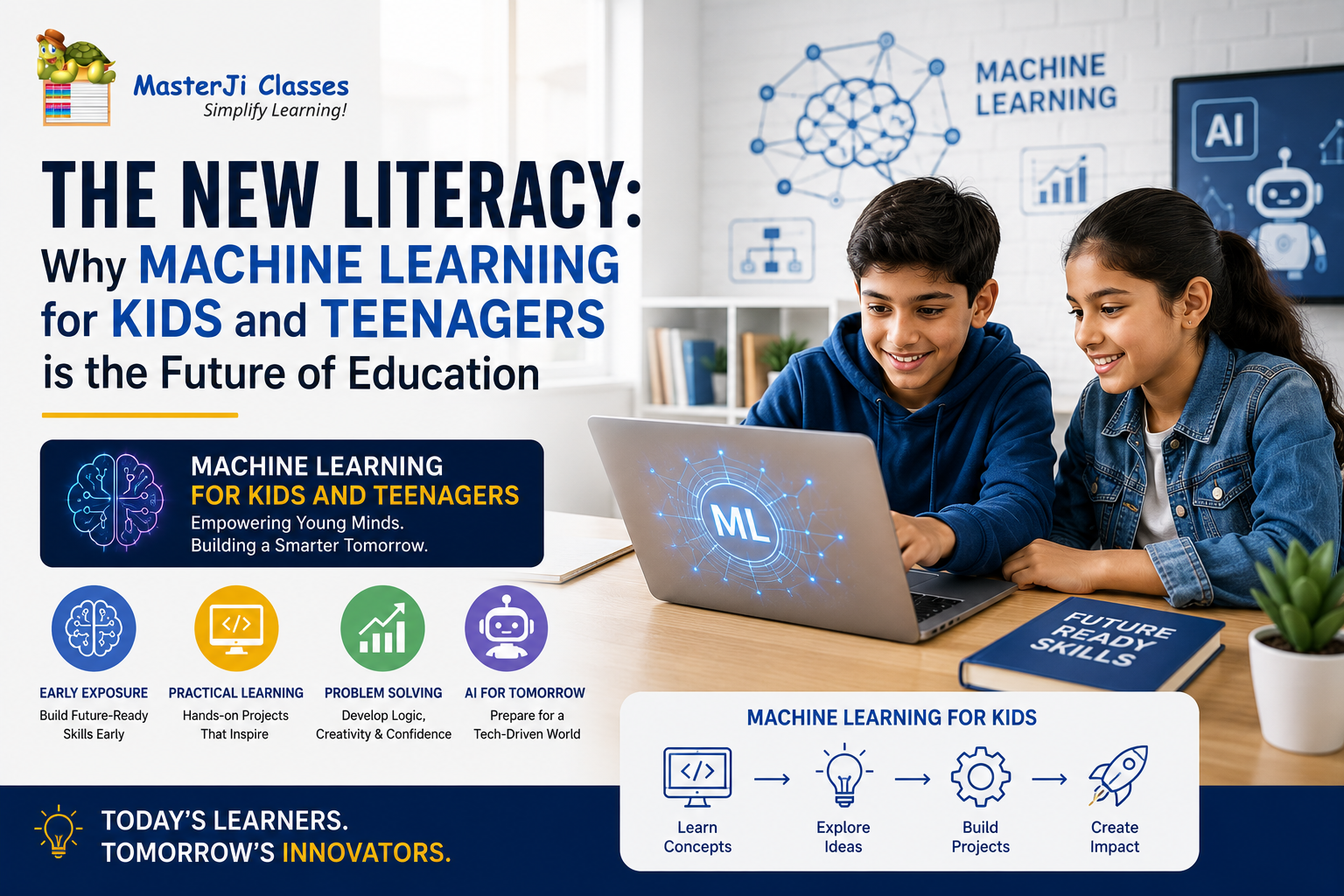
This leads to an important question that parents and educators must face: how can we prepare our children for the changes? The answer lies in the shift from being just “users” of technology towards being “creators” of it. Thus, Machine Learning for Kids and special programs for Teens have become a hot topic nowadays.
What exactly is Machine Learning? (The Simple Version)
Before moving to the topic of why children should learn it, let’s get rid of the technical terms involved in this discussion.
Normally, we order a computer to work by directing it by giving it a limited set of instructions—this is the idea of coding. For example, to ask a robot to bake a cake, we should explain to it what exactly to do every single step. If we forget to include “crack the eggs,” the robot will bake the whole eggs!
Machine Learning is not the same, as this is the science of teaching computers to learn from their experience, actually, like the humans do. Instead of giving a computer a recipe, it is much better to show it thousands of images of both successful and unsuccessful cakes. At the end of the day, a computer will “understand” what a good cake is based on the images it saw.
Why Machine Learning for Kids? (Ages 8–12)
You may ask yourself “ML is too tough for a kid of 10!” But updated news show children have more chances in understanding ML, they tend to be more curious about patterns. The aim of Machine Learning for Kids isn’t to use complex calculus equations or heavy Python programming. The aim is logic mixed with play.
1. Turning Curiosity into Skill
Children interact with ML on a daily basis. YouTube offering some videos or Alexa understanding them, this is the real life of ML. By showing them the “how” behind it they can spend their time usefully.
2. Building “Pattern Literacy”
The heart of ML is spotting patterns. After learning how a computer organizes information children improve their understanding of the world and their abilities to predict something.
3. Democratizing Creativity
Thanks to new no-code ML programs kids can do some amazing things. For example, they can learn a computer to read their body language for the game or to understand whether their cat is a real one or a stuffed toy.
Machine Learning Courses for Teenagers: Building a Career Edge
As students move into their teenage years, the conversation shifts from “play” to “purpose.” For high school in the United States and across the globe, the competition for college admissions and internships is fiercer than ever.
This is where Machine Learning Courses for Teenagers come into play. These courses are designed to take a student’s basic interest in tech and turn it into a professional-grade skill set.
1. Beyond Basic Coding
Most teenagers today know the basics of Scratch or perhaps a little Python. But ML takes them deeper. They learn how to handle data sets, understand “Neural Networks,” and work with libraries like Tensor Flow or Py Torch. This is the stuff that Silicon Valley is built on.
2. The Ethics of the Future
One of the most trending topics in recent news is the ethical use of AI. From “deep fakes” to algorithmic bias, the world is struggling to keep up with the moral implications of technology. Specialized courses for teenagers don’t just teach the code; they teach the responsibility. Teens learn to ask: “Just because we CAN build this, SHOULD we?”
3. A Massive Resume Booster
Whether a student wants to go into medicine, law, fashion, or sports, ML will be there. A teenager who understands how to analyze data using machine learning will be an asset in any field. Imagine a medical student who can build an ML model to help detect early-stage diseases—that is the level of innovation these courses prepare them for.
The Latest Trends: What’s New in ML Education?
- Recent technological news of 2024 highlights a number of important trends.
- Generative AI has arrived: children have moved from merely creating simple classification programs to learning how “Generative AI” works and studying prompt engineering which allows creating effective communication with AI.
- AI has become socially responsible: there is growing popularity of the application of AI for solving social or community problems. Students utilize their analytical skills to develop local solutions, e.g., discovering native plants or creating tools for learners with dyslexia.
- Use of technologies in schools: although many schools have yet to adopt the new technologies, private training companies have already introduced their courses for children, thereby closing the gap of knowledge and skills between traditional schooling and modern technological economy.
How to Get Started: The Road Map
If you are a parent looking to introduce your child or teenager to this world, here is a simple path:
Step 1: Start with “Unplugged” Activities (For Kids)
Talk about how the Netflix recommendation engine works. Play games that involve sorting and logic. Make them realize that the “magic” in their phone is actually just very smart math.
Step 2: Use Visual Learning Tools
Platforms like “Machine Learning for Kids” (a tool that uses Scratch) allow younger students to build ML models by dragging and dropping blocks. It’s fun, visual, and provides instant gratification.
Step 3: Enroll in Professional Courses (For Teenagers)
For older students, it’s time to get serious. Look for Machine Learning Courses for Teenagers that offer mentorship. Learning from a video is one thing, but having a mentor to explain why a model isn’t working is invaluable.
Step 4: Build a Project
The best way to learn ML is to build something. Encourage your child to find a problem they care about—be it climate change, sports stats, or music—and try to build an ML project around it.
Conclusion: Don’t Just Watch the Future, Build It
The rise of Artificial Intelligence is the “Industrial Revolution” of our time. Just as our grandparents had to learn how to use engines and our parents had to learn how to use the internet, the current generation must learn to master Machine Learning.
By introducing Machine Learning for Kids early on, we remove the fear of the unknown. By providing Machine Learning Courses for Teenagers, we give them the tools to lead the next wave of global innovation.
The goal isn’t to turn every child into a computer scientist. The goal is to ensure that every child is “AI literate.” In a world where machines are learning, our children must be the ones who teach them.
If you’re looking for a place to start this summer, programs like the Contact Master Ji Summer Camp are specifically designed to make these complex topics accessible, fun, and life-changing. The future isn’t something that just happens—it’s something we build, one line of code at a time.