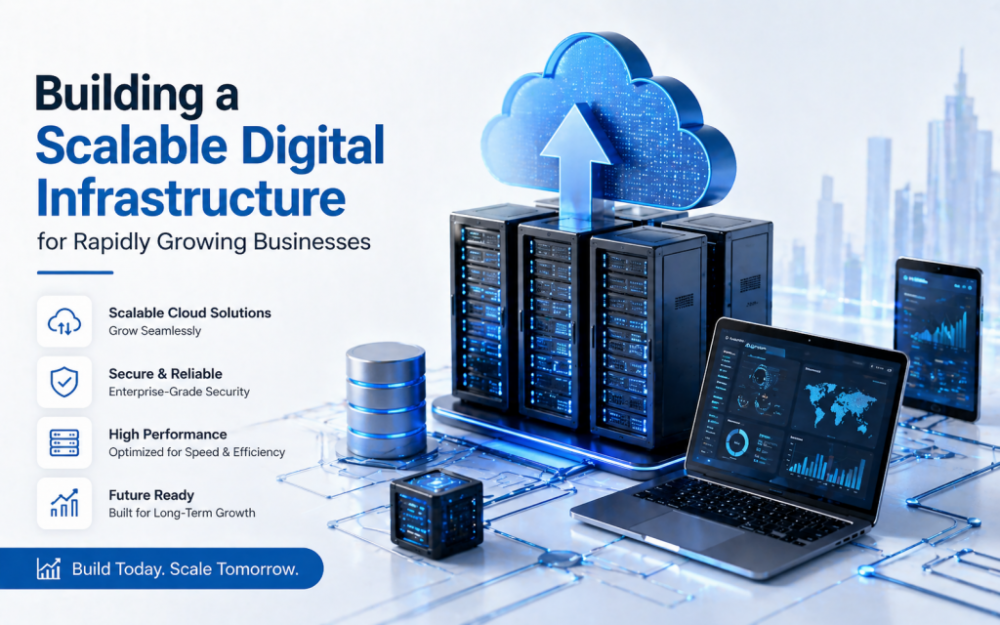
meet the demand without slowing down the operations. A Scalable Digital Infrastructure enables business organizations to grow seamlessly, handle the growing workloads, and provide consistent performance at all levels of growth. Having reliable partners such as Quickdice and having access to the best erp software in Saudi Arabia, businesses can streamline operations and establish a solid base that can help achieve success in the long term.
There should never be a struggle to grow. With a technology that is scalable, your team is able to concentrate more on innovation, customer satisfaction and expansion of the market rather than on the constraints of the system. This is what makes a future ready infrastructure an intelligent investment in any business that is on the rise.
The Ultimate Guide to Scalable Digital Infrastructure for Growth
What is Scalable Digital Infrastructure?
A Scalable Digital Infrastructure is a scalable technology platform that scales with your business. It comprises systems, applications and platforms that are capable of managing the high demand without sacrificing speed or reliability. Businesses can increase or decrease resources when the need arises instead of having to replace systems when there is expansion.
This adaptability assists organizations to remain effective in stable growth and abrupt surges in demand. It also makes sure that the performance is not compromised which is critical in developing trust with customers.
Why Scalability is Essential for Business Growth
With increased business, there is an increase in traffic, data and operational pressures. Such changes may cause delays, downtime and lost opportunities without the appropriate infrastructure.
An effective Scalable Digital Infrastructure helps a business to grow with confidence. It facilitates the running of operations, better response times, and assists teams to be more efficient. And above all, it enables businesses to work on value delivery rather than system troubleshooting.
Key Elements of a Strong Scalable Infrastructure
Cloud Flexibility
Cloud services enable companies to grow resources according to the real-time requirements. This will be flexible to control the costs but maintain the same performance when the demand is high.
Smart Data Handling
Data systems are more efficient, thus facilitating storage, processing and accessing of large amounts of information. This is essential in decision making and the speed of operation.
Reliable Network Systems
A robust network will guarantee the effective flow of messages between applications and the users. Load balancing assists in balancing traffic, thus minimizing chances of system overload.
Automation for Efficiency
Automation software minimizes the number of people working and enhances precision. They enable the businesses to react fast to the changes and ensure stability in performance.
Integrated Business Solutions
ERP systems tie the various business functions to a single platform. This increases visibility, control and facilitates a smooth scaling between departments.
Practical Strategies to Build Scalable Systems
Start with a Flexible Design
Select systems that are able to expand with your business. Modular designs enable you to expand particular sections without influencing the whole set up.
Move to the Cloud
Cloud-based solutions have the flexibility and speed of the modern growth. They assist the companies to respond to demands in real-time by shifting resources.
Use Automation Wisely
Automation enhances efficiency and minimizes the possibility of human error. It is also useful in sustaining performance at peak times.
Plan for the Future
Knowing your growth patterns will enable you to plan on what is to come. Constant monitoring and planning will avoid delays and bottlenecks.
Keep Security Strong
The bigger the business, the larger the data protection will be required. High levels of security guarantee secure operations and customer confidence.
Types of Scaling Approaches
Vertical Scaling
The approach augments the capacity of the existing systems. It is easy but it has constraints as the demand increases tremendously.
Horizontal Scaling
This approach adds more systems to share the workload. It is more flexible and suitable in companies that grow quickly.
Common Challenges and How to Overcome Them
Scaling does not necessarily come easy. The businesses can be burdened with problems such as complexity of the system, increase in cost or integration problems. The trick is to think things through and to select the appropriate technology partners.
Companies can address these issues by investing in the appropriate tools and strategies and develop a system that can help them grow in the long term.
Benefits of Investing in Scalability
An architected Scalable Digital Infrastructure provides real business value:
- The continuous and consistent growth.
- Better operational efficiency
- Improved customer experience
- Quick innovation and flexibility.
- Lower long-term costs
Conclusion
Building a strong digital foundation is one of the smartest decisions a growing business can make. A Scalable Digital Infrastructure will provide you with the ability to support more demand with your systems without compromising performance and reliability. It will enable your business to expand endlessly and easily to meet the dynamic market needs.
Scalability is not just a technical capability with the appropriate approach. It makes it a growth strategy that leads to success, efficiency and enables your business to remain competitive in this competitive world.