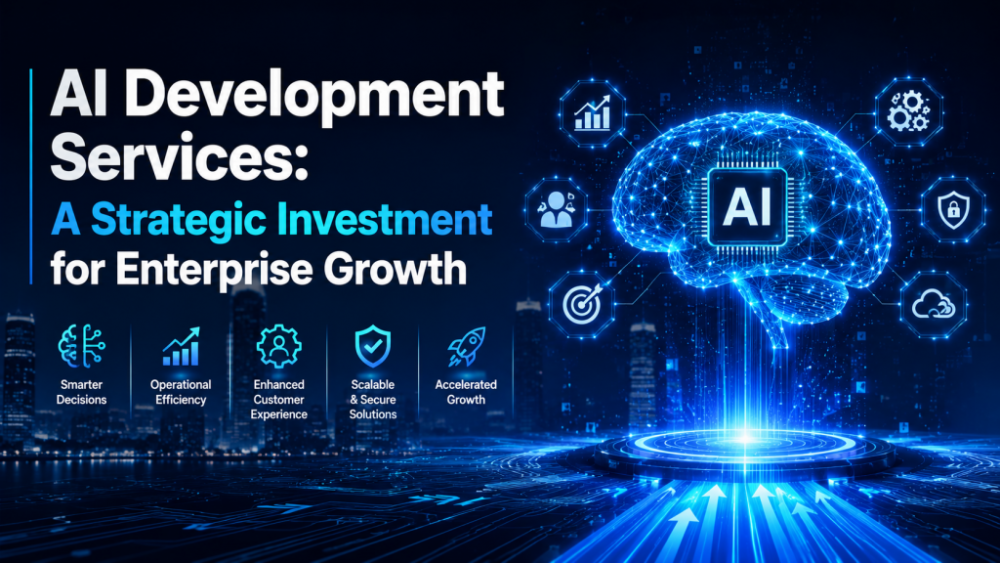
AI Development Services: Why Smart Enterprises Are Betting Big on Artificial Intelligence
Let’s be honest, a few years ago, “AI strategy” was something you’d hear in Silicon Valley boardrooms or futuristic TED Talks. Today? It’s the conversation happening at every executive table, from mid-sized logistics firms in Pune to retail chains expanding across Southeast Asia.
And for good reason.
The businesses that started investing in AI early aren’t just saving time and money; they’re pulling ahead in ways that are increasingly hard for competitors to catch up to. So if you’re still sitting on the fence about AI development services, this piece will help you understand what’s actually at stake.
So, What Exactly Are AI Development Services?
Think of AI development services as a broad toolkit. It’s not just about building a chatbot or automating an email response. It covers the entire journey, from figuring out which AI solution makes sense for your business, to building it, deploying it, and making sure it keeps improving over time.
Practically speaking, this includes things like:
- Building custom machine learning models that learn from your data
- Developing generative AI apps (think internal knowledge tools or AI writing assistants)
- Creating smart chatbots and virtual agents for customer support
- Setting up computer vision systems for quality inspection or inventory tracking
- Designing predictive analytics tools for forecasting demand, spotting fraud, or reducing churn
The best AI development work isn’t off-the-shelf software; it’s solutions designed around how your specific business actually operates.
Why Are Companies Rushing to Adopt AI Right Now?
A few things have collided at the right moment to push AI from “nice-to-have” to “business critical.”
Data overload is real. Companies are swimming in more data than any human team can meaningfully process. AI doesn’t just store or sort that data, it turns it into decisions.
Customer expectations have shifted permanently. People expect fast, relevant, personalized experiences. Not in an ideal world, right now, every time they interact with a brand. AI is what makes that level of personalization possible at scale.
The competition isn’t waiting. If your rivals are using AI to speed up their operations, improve targeting, and cut costs, and you’re not, that gap grows every quarter.
Generative AI changed the playing field.Tools built on large language models have opened up entirely new use cases: automated content creation, intelligent search across enterprise knowledge bases, AI copilots that actually help employees get things done faster. This wasn’t possible at scale just a few years ago.
What Can AI Actually Do for Your Business?
Let’s get specific, because “AI improves efficiency” is a phrase that’s lost all meaning through overuse. Here’s what that actually looks like in practice.
Cutting the Grunt Work
Every business has processes that eat up hours but don’t require much thinking, data entry, invoice processing, scheduling, generating routine reports. AI handles these reliably and without complaint, freeing your team to focus on things that genuinely need human judgment.
Making Faster, Smarter Decisions
Imagine having a system that monitors your sales pipeline, flags which deals are most likely to close, identifies which customers are drifting toward a competitor, and surfaces all of this in a dashboard, without you having to pull reports or run spreadsheets. That’s what well-built AI can do.
Customer Experience That Actually Feels Personal
AI recommendation engines, smart chatbots, and predictive support tools allow businesses to treat each customer like the system “knows” them, without a human agent having to review their full history every time. Done well, this dramatically improves satisfaction scores and retention.
Finding Revenue You’re Leaving on the Table
Lead scoring, dynamic pricing, smarter upsell recommendations, AI doesn’t just cut costs, it actively helps you grow revenue. Many businesses discover that the ROI from AI-driven sales optimization alone covers the entire investment.
Which Industries Are Seeing the Biggest Impact?
AI isn’t a one-industry story. Here’s where it’s making the most noise right now:
Healthcare Clinical teams are using AI to support diagnosis, automate documentation, and manage patient monitoring. It’s not replacing doctors; it’s reducing the administrative burden so doctors can actually focus on patients.
Finance
Fraud detection, credit risk assessment, algorithmic trading, financial institutions were early AI adopters, and they’ve built significant advantages as a result.
Retail & E-commerce
From personalized product feeds to inventory optimization, retail AI directly impacts conversion rates and margins.
Manufacturing
Predictive maintenance alone can save manufacturers millions by catching equipment issues before they become breakdowns.
Logistics
Route optimization, demand forecasting, warehouse automation, AI has become the backbone of modern supply chain management.
“But What About the ROI?” — A Fair Question
Implementation costs are real, and it’s reasonable to ask whether the investment pays off. The honest answer is: it depends heavily on how you approach it.
Businesses that see strong ROI from AI tend to share a few things in common. They start with a specific, high-impact problem rather than trying to “implement AI” as an abstract goal. They ensure their data is clean and accessible before expecting models to do useful work. And they partner with AI developers who understand their industry, not just the technology.
When those conditions are in place, the returns can be significant through reduced operational costs, faster decision-making, improved customer retention, and new revenue streams that simply weren’t possible before.
What Does a Solid AI Implementation Actually Look Like?
Here’s the straightforward version of what works:
Start with a real business problem
Not “let’s use AI”, but “we’re losing 18% of customers after their first purchase, and we don’t know why.” That’s a problem AI can solve.
Get your data house in order
AI is only as good as the data it learns from. Garbage in, garbage out — this hasn’t changed.
Pick your battles.
Don’t try to AI-transform your entire business overnight. Start with one or two use cases where the impact is measurable and the data is available.
Think about governance early.
Who owns the model? How do you audit its decisions? What happens when it’s wrong? These aren’t annoying compliance questions; they’re important for building systems you can actually trust.
The Challenges Are Real, and Manageable
AI adoption isn’t without friction. Data quality issues, integration headaches with legacy systems, skills gaps on internal teams, regulatory compliance, these are legitimate obstacles. The businesses that navigate them well typically do so with a strong external partner who has been through these challenges before.
Choosing that partner matters enormously. Look for deep experience in your industry, a track record of completed projects (not just glossy proposals), and a team that’s honest about what AI can and can’t do, rather than promising you the moon.
Looking Ahead
The AI landscape is evolving quickly. Autonomous AI agents that can complete complex tasks without step-by-step human instruction, multimodal models that can work across text, images, and voice simultaneously, highly specialized industry-specific models, these aren’t distant concepts. They’re emerging now.
The organizations building their AI capabilities today will have a significant head start when these next-generation tools become mainstream.
The Bottom Line
AI development services aren’t about chasing a trend. They’re about giving your business a genuine, durable edge, in how efficiently you operate, how well you serve customers, and how quickly you can adapt to change.
The technology is mature enough to deliver real results. The use cases are proven across industries. The question now isn’t really whether to invest in AI, it’s how to do it intelligently, with the right partner and the right problems to solve.
The businesses making that move now won’t just be more efficient. They’ll be the ones setting the pace that everyone else is trying to match.