Technology decisions often begin with an appealing question: What is the best tool, platform, architecture, or system available? That question sounds sensible, but it can send teams in the wrong direction because the technically strongest option is not always the right choice for the business using it.
A better starting point is to ask what the organization can realistically support, afford, operate, and change. Budget limits, existing systems, employee skills, compliance requirements, delivery deadlines, customer expectations, and risk tolerance all shape what a sensible technology decision looks like.
When those constraints are understood before solutions are compared, IT stops being a collection of isolated technical choices. It becomes a practical way to solve business problems within conditions the company actually faces.
A Good Technical Choice Can Still Be a Bad Business Choice
Technology teams naturally evaluate options based on features, performance, scalability, security, maintainability, and technical fit. Business leaders often look at the same decision through cost, revenue impact, time to market, staffing, and operational disruption.
Neither view is wrong. Problems begin when one is considered without the other.
Imagine a company choosing between extending an existing business application and rebuilding it on a newer technology stack. A rebuild may produce cleaner architecture and remove years of technical debt, but it may also require months of engineering work, employee retraining, data migration, and temporary disruption to normal operations.
If the company has an important market launch in six months, rebuilding everything may create more risk than value. Extending the existing system while replacing selected components could be the stronger business decision, even if it is less attractive from a purely technical perspective.
This is why experienced technology planning starts with context rather than tools.
Constraints Are Inputs, Not Obstacles
The word “constraint” often sounds negative. Teams may treat budget ceilings, deadlines, legacy systems, or staffing shortages as barriers preventing them from building what they really want.
In practice, constraints are useful decision inputs. They narrow the number of possible choices and help teams focus on options that can survive outside a planning document.
A company with a small internal engineering team should think carefully before adopting a highly specialized platform that requires uncommon skills. A business operating in a regulated sector must consider data handling requirements before selecting cloud services. A growing startup with limited cash may need a technology path that postpones major infrastructure spending until demand justifies it.
Understanding these boundaries does not lower the standard of technology planning. It makes the plan more realistic.
Start With the Business Outcome
One common IT planning mistake is beginning with a product or technology rather than the problem being solved. Conversations quickly turn into debates about cloud vendors, AI models, programming frameworks, platforms, or architecture patterns before the desired business result is clearly defined.
A better discussion begins with questions such as: What business problem are we trying to solve? What changes if we solve it? How quickly does the company need the result? What level of risk is acceptable? What resources are available?
For example, a business may initially believe it needs a complete customer service platform replacement. Further analysis might reveal that the real problem is slow access to customer information across several existing systems.
Once the business issue is defined properly, the company has more options. It might improve data access, replace one part of the current system, automate a repetitive workflow, or introduce a new platform gradually rather than replacing everything at once.
This type of assessment is also where experienced IT consulting services can be useful. The value is not simply choosing technology, but connecting technical possibilities with business priorities, existing systems, cost limits, and operating realities.
Budget Means More Than Purchase Price
Technology costs are often underestimated because decision makers focus heavily on the initial purchase or development expense. The real cost usually continues long after the system goes live.
Licensing, hosting, maintenance, security monitoring, employee training, support, vendor management, future upgrades, and specialist hiring can all affect the long-term financial picture. A solution that appears inexpensive during selection can become costly once the company has to operate it for several years.
Internal time should also be treated as a cost. If experienced employees spend hundreds of hours supporting a new platform, troubleshooting problems, or learning unfamiliar tools, those hours are no longer available for other business priorities.
A realistic IT decision therefore asks not only, “Can we afford to buy or build this?” but also, “Can we afford to own and operate it?”
Existing Technology Changes the Answer
Few organizations make technology decisions from a blank slate. Most already have applications, databases, infrastructure, vendor contracts, workflows, security controls, and years of accumulated data.
Any new system must live within that environment.
A platform may look excellent during a product demonstration but require extensive changes before it can work with existing applications. Another solution may offer fewer advanced features yet connect more easily with systems employees already depend on.
The second option can sometimes provide greater business value because it reduces migration work, lowers operational risk, and allows employees to adopt the change faster.
This is especially important when legacy systems support critical operations. Replacing them simply because newer technology exists can create unnecessary risk. The stronger approach may involve modernizing selected parts while keeping stable components in place until there is a clear business reason to replace them.
People Are Part of the Technology Decision
Companies often evaluate software architecture carefully while paying far less attention to whether their teams can actually support it. That is a mistake because technology capability depends heavily on people.
A company may choose a technically sophisticated system and later discover that it does not have the internal skills to maintain it. Hiring specialists could take months, while relying permanently on a vendor may increase cost and dependency.
Before making a major technology choice, leaders should assess the skills they already have, the skills they can reasonably hire, and the areas where external expertise makes sense.
For projects where internal technical leadership is limited, organizations may choose to hire IT consultants and tech leads for architecture reviews, technical planning, delivery oversight, or specialist guidance rather than immediately building a permanent senior team.
The important point is that staffing strategy should be considered while the technology decision is being made, not after contracts are signed.
Time Constraints Can Change the Architecture
The ideal architecture for a three-year platform program may be very different from the right architecture for a product that needs to reach customers within four months.
Time affects how much software can be replaced, how much testing can be completed, how much employee training is practical, and how much operational change a company can absorb.
When deadlines are tight, teams should distinguish between requirements that must be solved now and improvements that can be introduced later. This can lead to smaller releases, staged migrations, limited pilots, or reuse of proven services rather than rebuilding every component.
Taking a staged approach does not mean ignoring the future. It means designing a path where early decisions leave reasonable options open for later changes.
Risk Tolerance Differs From One Business to Another
Two companies facing the same technical problem may reasonably choose different solutions because their tolerance for risk is different.
A financial services company handling sensitive customer information may place strict controls around data storage and third-party services. An early-stage product company testing a new market may accept more technical uncertainty in exchange for faster learning and lower initial spending.
Business criticality matters too. An internal reporting tool can usually tolerate more disruption than a payment system responsible for processing customer transactions.
The decision process should therefore identify what can go wrong, how serious the consequences would be, and how much risk the company is prepared to carry. This makes architecture discussions more grounded because technical risks can be compared with actual business impact.
Constraints Should Be Ranked, Not Just Listed
Most projects have several constraints at the same time. The difficult part is deciding which ones matter most.
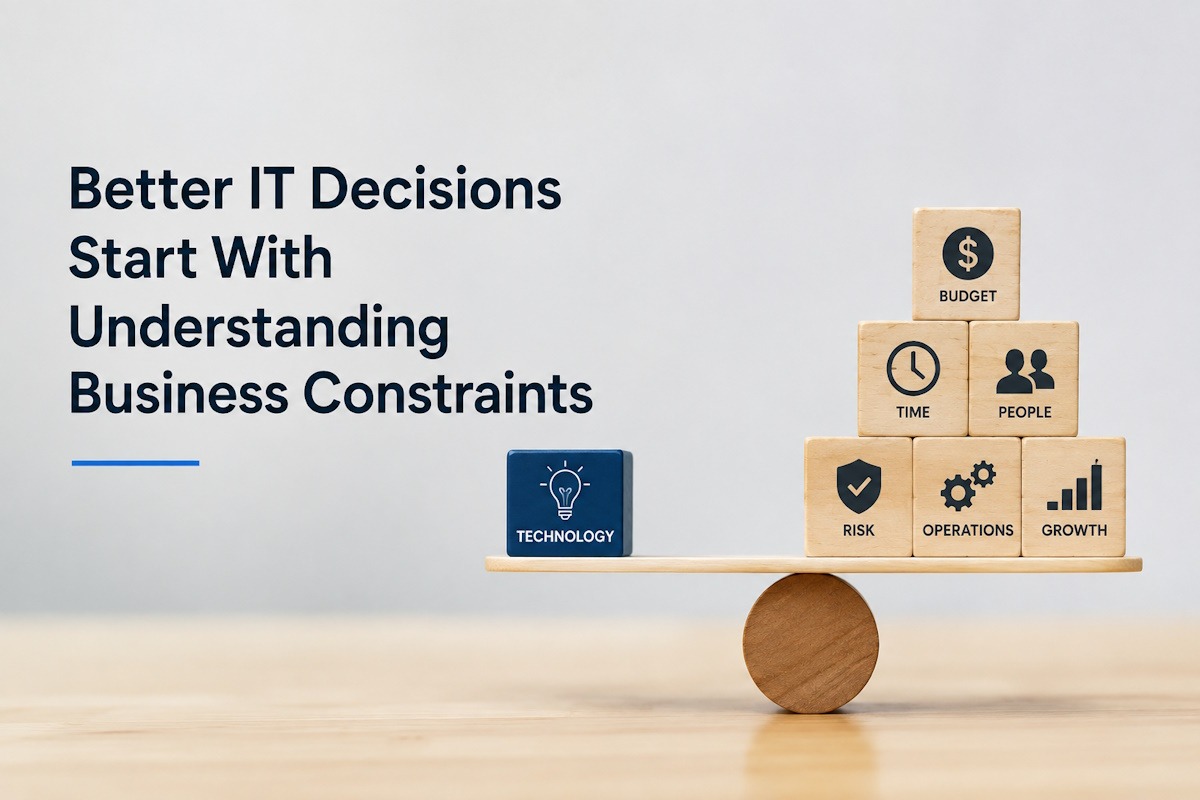
A company might have a fixed launch date, a limited budget, strict security requirements, and a shortage of developers. Trying to treat every constraint as equally flexible can lead to unrealistic planning.
Leadership needs to decide which conditions cannot change and which ones have room for negotiation. The launch date might be fixed because of a contractual commitment, while the first release could contain fewer features. Security standards may be non-negotiable, while infrastructure spending may have some flexibility.
Once priorities are visible, technology teams can make trade-offs deliberately instead of discovering them during development.
Better Decisions Come From Better Questions
Strong IT decisions rarely come from finding a universally superior technology. They come from finding the technology approach that best fits a specific company, problem, and set of operating conditions.
That means asking questions before comparing products. What outcome matters? What systems already exist? How much change can the organization handle? Which skills are available? What risks cannot be accepted? How much time and money can realistically be committed?
These questions may seem less interesting than discussing the newest platforms or architecture trends, but they often determine whether a technology project delivers lasting value.
The Best Technology Is the One the Business Can Use Well
Technology strategy becomes more useful when technical ambition is balanced with business reality. Constraints provide the boundaries needed to make that balance visible.
A decision that respects budget, people, deadlines, existing systems, operational needs, and risk is more likely to survive contact with the real organization. It may not always produce the most technically impressive system, but it can produce something far more valuable: technology that the business can adopt, operate, and use to move forward.