Just a few years back, cloud computing had disrupted software development in a big way. Today again, there is another disruption. This is bringing about one of the biggest workflow changes in how applications are built and deployed.
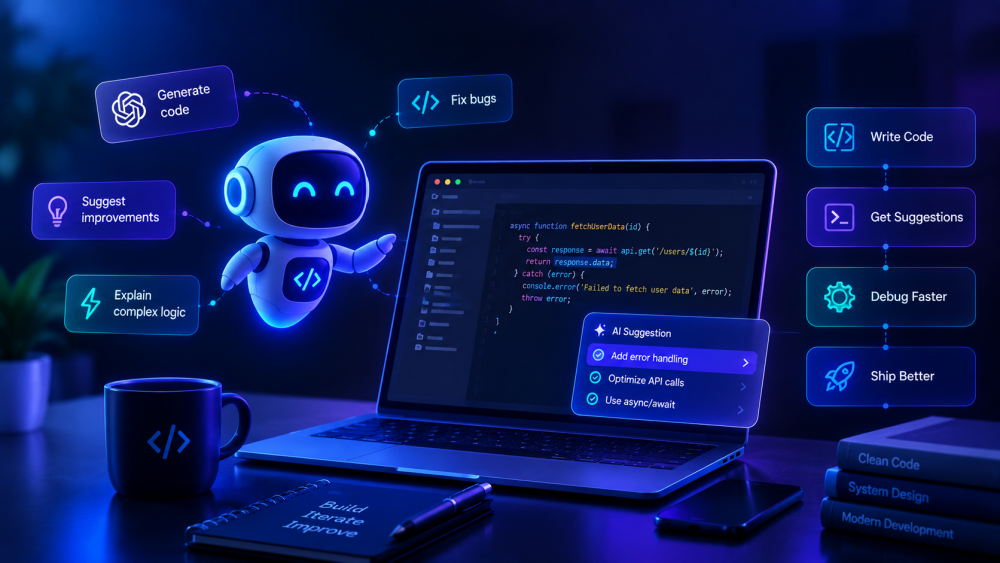
Gone are the days when developers would rely on IDEs, documentation, search engines, and manual coding. AI coding assistants have ushered in a new era in everyday software development by:
- Helping programmers generate code
- Understand unfamiliar repositories
- Write tests for quality assurance
- Troubleshoot bugs and errors
- Refactor different functions
- Plan implementation approaches
The 2025 Developer Survey conducted by Stack Overflow found that 84% of respondents were either already using or planning to use AI tools in their software development process. Also, 51% of professional developers said they used them daily.
But this blog is not about whether developers are using AI. Everyone is talking about that. Here, we will focus on how AI is shifting developer focus from writing code to other critical tasks.
From Writing Every Line to Directing the Development Process
Traditionally, the development phase was synonymous with translating client requirements manually into code. Developers analyzed insights gathered during the discovery phase and wrote functional code based on them. They would then spend time checking its syntax accuracy, creating boilerplate, debugging issues, and then repeating the process again.
With AI-assisted software development, developers have more flexibility now. They can just describe a required function, generate an initial implementation, and ask AI to explain its edge cases. After this, AI creates unit tests to identify potential problems and refine the solution. This shifts the development cycle from:
Intent → Generate → Review → Test → Refine → Integrate to Plan → Code → Test
To
Plan → Code → Test
The process becomes simple and shorter. The gain is a reduction in repetitive work. Modern AI coding tools reduce the effort required to generate data models, API structures, test cases, documentation, SQL queries, regular expressions, and framework-specific boilerplate.
Code Generation Is Only the Beginning
Newer AI code completion tools can work across multiple files, answer questions about codebases, suggest refactoring strategies, generate tests, investigate bugs, and perform increasingly complex development tasks. The result: more sophisticated and efficient AI-driven development workflows that improve efficiency across different stages of the software development lifecycle like:
- Requirement interpretation and technical planning
- Architecture exploration
- Code generation and refactoring
- Unit and integration test creation
- Debugging and root-cause investigation
- Documentation generation
- Code review assistance
- Performance and security analysis
Once he lets go of the repetitive code writing process, a developer can play a bigger role as a technical decision-maker who guides, evaluates, and validates machine-generated work.
But Code Verification Is A Challenge
Who verifies code quality? This is a critical question to ask with AI-assisted software development gaining rapid popularity. Software quality assurance is one of the biggest challenges developers face when leveraging AI for coding.
According to the Stack Overflow 2025 survey referred to above, 46% of developers have questions regarding the accuracy of AI output as against 33% who trust it. This increases engineering responsibility, and developers need to verify the following when creating an important change in engineering responsibility.
- Whether generated code actually solves the requirement
- Whether edge cases have been considered
- Whether dependencies are appropriate
- Whether security vulnerabilities have been introduced
- Whether the implementation follows internal architecture standards
- Whether generated tests genuinely test the right behavior
- Whether the code will remain maintainable over time
While there is little doubt that AI coding assistants reduce coding efforts, verifying the accuracy of the code is a challenge that developers must resolve before they can integrate this within the software development lifecycle. However, this challenge is manageable and can be overcome using the right prompts and rigorous automated testing.
AI Amplifies the Engineering System Around It
Let’s understand this by looking at DORA’s research on AI-assisted software delivery. According to this research, AI is software development primarily works as an amplifier. Most AI-native web and custom development companies use it to augment their existing strengths. But AI development also tends to scale up the weaknesses present in the processes, platforms, testing, documentation and delivery practices they are integrated into.
Simply put, purchasing and integrating AI subscriptions does not increase engineering productivity automatically.
How to overcome this challenge?
Teams need a stronger foundation. This includes better clarity on coding standards to be maintained. They also need to increase the:
- Efficiency of automated testing
- Reliability of CI/CD pipelines
- Accessibility of documentation
- Observability of the process
- Stringency of security controls
- Effectiveness of code-review practices
Remember, the value of AI depends only on the environment in which developers use it. The better the environment created, the more accurate will be the output.
What Happens to the Developer’s Role?
The role of AI in modern software development is diverse. It focussed mainly on improving developer productivity, not undermining their importance. AI-driven development workflows are not autocomplete by default. They need a developer’s overview to ensure output quality and accuracy.
As assistants become increasingly capable, the developer’s role will shift from merely writing code to:
- Defining problems
- Supplying context
- Decomposing complex requirements
- Reviewing generated solutions
- Designing architectures
- Managing technical risk
- Validating results
This shift will require developers to upskill their capabilities. It will also make them versatile so they can add more value to the entire engineering process.
Conclusion: The Future Is Not AI Versus Developers
The future of software engineering with AI is bright. It will keep redefining different aspect of software engineering. But this success can only come when the entire process is developer-driven. This will change and enhance productivity.
Developers will increasingly work with systems capable of producing implementation options rapidly. Their competitive advantage will come from knowing which problems are worth solving. By giving AI the right context, identifying weak outputs, and making sound engineering decisions, they will collaborate with AI to develop software that works reliably in the real world.
AI is reducing the cost of generating code. And widespread AI adoption will not only ensure better code writing, but also better engineering of software solutions.