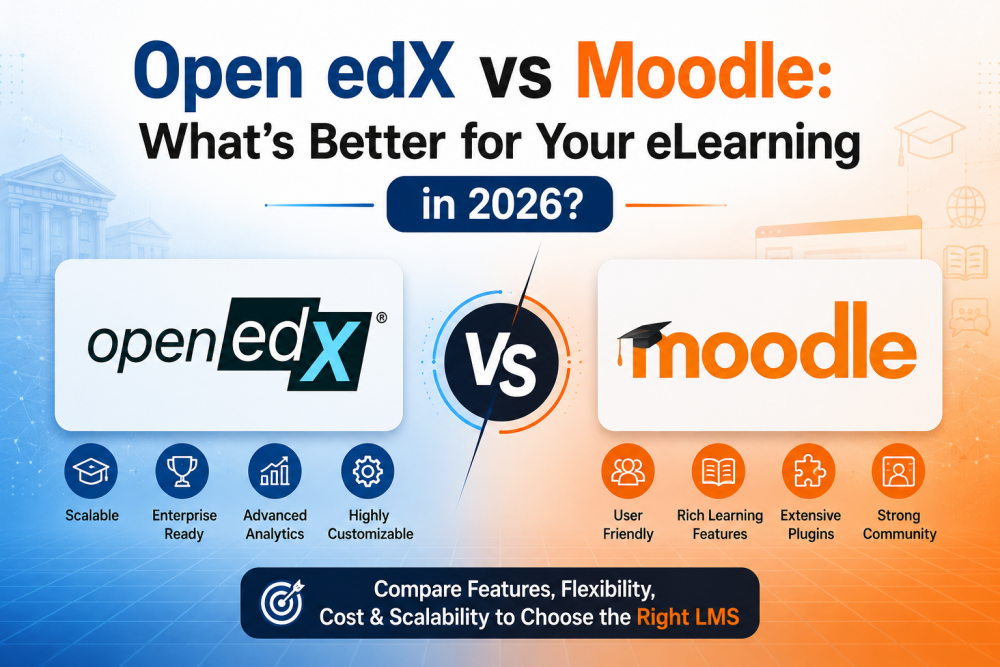
When teams discuss Open edX vs Moodle, the conversation quickly moves beyond features. Decision-makers want to know about internal support requirements. They must have clear visibility of hosting expenses they may incur, all the maintenance cycles, and long-term upgrade planning, too. More importantly, after the launch, who will manage the platform is another aspect they should understand.
The Open edX vs Moodle 2026 decision comes down to operational fit rather than popularity contests. Both platforms serve thousands of institutions worldwide, but they approach learning management differently. That difference becomes visible once implementation starts.
Where Each Platform Comes From
Any open-source LMS comparison should start with understanding how each system was built.
Moodle was built for education. It looks and feels like a traditional classroom with groups of students, teacher roles, grade books, and features that you can expand as needed. However, it now supports corporate training programs; education remains its core strength.
Open edX, on the other hand, was designed for massive open online courses (MOOCs). It has the framework that supports structured learning paths and centralized content libraries alongside high user volumes. And so, institutions that run global programs often choose it.
This foundational difference influences every Moodle vs Open edX conversation that follows.
How Both the Platforms Handle Growth
Infrastructure planning separates theory from practice in the Open edX comparison.
Moodle runs effectively on standard cloud hosting with reasonable technical oversight. Many medium-sized organizations manage it internally without extensive DevOps teams. Its plugin library lets administrators add functionality without touching core system code.
Open edX typically demands more careful deployment planning. Server setup, containerization, and version management require technical knowledge. However, this complexity enables predictable scaling. Organizations supporting thousands of learners often prefer to go on with this approach. Which makes it important for the organizations to hire experienced Open edX developers for the setup.
In a nutshell, whatever teame evaluate Open edX vs Moodle for eLearning at scale should assess infrastructure capacity early in the planning process.
Customization Approaches
Both platforms allow modifications, but the methods differ significantly.
When drawing a Moodle comparison, it usually emphasizes its plugin marketplace. New functionality can be added relatively quickly. This suits institutions needing rapid changes without deep engineering resources.
The Open edX comparison, in contrast, focuses on architectural flexibility more. So, building custom features requires significant structure development work. That demands experienced developers but delivers tighter integration across system components.
The choice becomes clear when framed properly. Moodle prioritizes configuration speed, and Open edX prioritizes system coherence.
Which path works better depends entirely on available technical expertise within the organization.
Integration With Other Systems
Modern learning platforms need to work with other tools. CRM platforms, payment processors, analytics dashboards, and video services must connect smoothly.
Moodle review discussions mostly point to plugin availability, which often gets highlighted as a major advantage. However, plugin quality varies considerably, and compatibility depends on active developer maintenance.
And if you look at some Open edX analysis, you will find that integrations usually happen through API development. This creates cleaner architecture over time but also increases the dependence on the skilled developers.
That makes custom integration projects cost more initially, but during future upgrades, it prevents unnecessary conflicts. Thus, talking about the integration aspect also matters during the Open edX vs Moodle 2026 planning discussion.
User Adoption Reality
Platform adoption determines whether an LMS actually succeeds.
Moodle’s interface has improved substantially in recent versions. Dashboard customization and mobile access have gotten better. Moreover, instructors typically adapt without extensive training.
Open edX provides a structured learning experience that works well for large programs with sequential content. However, administrators sometimes need training to navigate configuration options effectively.
Usability and technical features both matter when you’re deciding on the best LMS for eLearning 2026. The math is simple; one without the other doesn’t work.
True Cost Assessment
Both systems are open-source, but total ownership cost extends far beyond licensing.
Moodle deployments generally need lower initial investments and so, smaller institutions can very effectively operate without even having a large technical team.
Open edX may require higher setup costs due to infrastructure and development requirements. However, in enterprise environments, its built-in scalability may balance those expenses.
According to industry reports, universities and corporate learning departments are adopting open-source platforms in search of greater control over data management and hosting. And so, the debate upon Open edX vs. Moodle for eLearning makes more sense today!
Your cost plan needs to cover hosting, maintenance, upgrades, security, and developer support. Going after a cheap option today doesn’t mean much if the system becomes a nightmare later.
Security and Data Control
Data governance carries more weight in 2026 than it did five years ago.
Both platforms allow complete data control when self-hosted. Moodle has earned trust within academic institutions requiring strict compliance standards. Open edX gets selected for government and enterprise programs needing centralized oversight.
In a Moodle vs Open edX evaluation focused on compliance, the difference usually comes from implementation quality rather than platform limitations.
Choosing the Best Option
There is no universal winner in the Open edX vs Moodle debate. But here are a few instances and the preferred choices:
| Organization Type | Likely Fit | Reason |
| University with semester-based programs | Moodle | Instructor familiarity and plugin flexibility |
| Corporate L&D at a global scale | Open edX | Structured scalability and analytics depth |
| EdTech platform targeting MOOCs | Open edX | Designed for large enrollments |
| Small training institute | Moodle | Lower infrastructure overhead |
| Government training body | Open edX | Centralized control and scalability |
This table does not declare a winner. It clarifies alignment.
Final Considerations
Start the Open edX vs Moodle 2026 decision by asking basic questions. How many learners will the system support? What technical resources are available internally? How often will customization be required? Who will manage upgrades?
When framed this way, the open-source LMS comparison becomes practical rather than ideological.
For some organizations, Moodle remains the more manageable choice. For others, Open edX provides the structured architecture necessary for scale.
The best LMS for eLearning 2026 is not defined by feature volume. It is defined by how well the platform fits the organization’s technical capacity, growth expectations, and governance requirements.
That is the perspective that makes the Open edX vs Moodle decision meaningful rather than reactive.