Real-time features have become common in mobile apps.
Users expect messages to appear instantly, delivery status to update automatically, dashboards to refresh, notifications to arrive at the right time, and collaborative actions to appear without manual refresh. Real-time behavior is no longer limited to chat apps. It appears in marketplaces, delivery platforms, finance apps, healthcare apps, education apps, SaaS tools, and internal business systems.
That creates a higher standard for mobile development.
A real-time app needs to feel alive, but it also needs to feel stable. Users should not wonder whether a message was sent, whether a status changed, or whether the app is showing old information. Delays and inconsistencies can quickly reduce trust.
React Native can be useful for real-time mobile apps because it supports cross-platform interfaces, reusable components, and flexible integration with real-time APIs and backend services. But real-time features also need careful planning around performance, state, notifications, offline behavior, and error handling.
The app should not only update quickly. It should update clearly.
Real-time UX is about feedback
A real-time feature is only valuable if users understand what is happening.
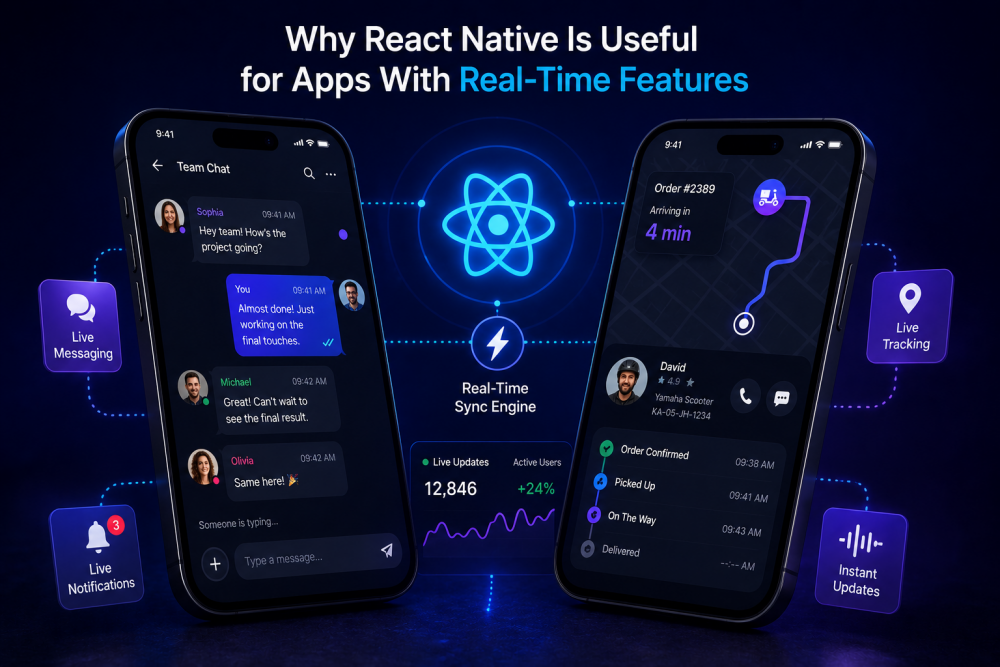
For example, a chat app should show when a message is sending, sent, delivered, or failed. A delivery app should show whether a driver location is live or delayed. A collaborative task app should show when another user changes something. A payment app should show whether a transaction is pending or complete.
React Native can help teams build consistent status components for these interactions.
Loading states, pending states, retry buttons, timestamps, badges, and notification banners can all be reused across the app. This helps users trust the experience even when the network is imperfect.
The goal is not just instant updates. The goal is confidence.
Chat and messaging require careful state management
Messaging is one of the most common real-time features.
It may appear in customer support, marketplaces, healthcare apps, education platforms, team collaboration tools, or service booking apps. A chat interface looks simple, but it includes many details: message sending, delivery status, read states, attachments, typing indicators, push notifications, offline handling, and conversation history.
React Native can support chat interfaces well, but state management needs to be clean.
The app needs to know which messages are local, which are confirmed by the server, which failed, and which are new. If this is handled poorly, users may see duplicated messages, missing messages, or confusing ordering.
Real-time messaging requires more than displaying text bubbles. It needs reliable data flow.
Live tracking must balance accuracy and performance
Location tracking is another common real-time feature.
Delivery apps, ride apps, field service apps, logistics tools, travel apps, and safety apps may all need some form of tracking. Users expect the map or status to update regularly, but too many updates can affect battery life and performance.
React Native can support tracking experiences, but teams need to design update frequency carefully.
Not every use case needs second-by-second updates. Some apps need near real-time precision. Others only need periodic updates. The app should match the user’s expectations without wasting device resources.
Map screens also need optimization. Heavy markers, large datasets, and frequent re-renders can make the app feel slow.
A good live tracking experience feels accurate enough to be useful and efficient enough to be practical.
Push notifications need context
Real-time apps often depend on push notifications.
A user may need to know about a new message, assigned task, order update, payment alert, booking change, or support reply. Notifications can improve engagement, but they can also become noisy.
React Native apps can support notification flows, but product strategy matters.
A notification should be relevant and actionable. It should bring the user back into the app for a clear reason. If users receive too many alerts, they may disable notifications, and the real-time experience becomes weaker.
Good notification systems consider priority, timing, user preferences, and context.
For real-time apps, notification quality is part of trust.
Offline behavior still matters in real-time apps
Real-time apps do not always have perfect connectivity.
A user may lose connection while sending a message, tracking an order, completing a task, or viewing a live dashboard. If the app simply breaks, the experience feels unreliable.
React Native can support offline-aware behavior, but the team needs to plan it.
The app should show when it is offline. It should save certain actions when appropriate. It should retry safely. It should explain what has synced and what has not. It should avoid pretending data is live when it is stale.
This is especially important for apps involving money, support, logistics, healthcare, or operational workflows.
A real-time app needs honesty. If the data is delayed, the user should know.
Real-time features need strong backend coordination
The frontend is only one part of a real-time app.
The backend must support timely updates, event delivery, authentication, permissions, and reliable state changes. A React Native app can display real-time data, but the experience depends on the quality of the systems behind it.
Teams need to decide how updates are delivered, how conflicts are handled, how stale data is detected, and how the app recovers from failures.
This is where React Native real-time app development should be viewed as a full product architecture effort, not just a UI project. The mobile app needs to work smoothly with APIs, sockets, event systems, notification services, and databases.
If those pieces are not aligned, the user experience will suffer.
Performance needs continuous monitoring
Real-time features can put pressure on mobile performance.
Frequent updates, live lists, animations, location changes, message streams, and dashboard refreshes can all create rendering and memory challenges. React Native apps need careful performance monitoring when real-time behavior becomes central.
Teams should watch re-renders, list performance, event subscriptions, memory usage, background behavior, and battery impact.
Real-time apps should also be tested under realistic conditions. A feature may work well with one user but behave differently with many updates, poor network, or older devices.
Performance should be part of the design, not a late fix.
The right team helps prevent real-time chaos
Real-time apps can become complicated quickly.
A simple chat or status update feature can grow into a system involving notifications, offline queues, retries, presence indicators, permissions, and analytics. This is why dedicated React Native developers matter when real-time features are important.
Good developers understand how to structure state, manage subscriptions, optimize rendering, handle network changes, and keep the UI understandable. They also know when the app needs native-level handling or backend coordination.
Real-time experiences require careful engineering because users notice mistakes immediately.
Final Thoughts
React Native is useful for mobile apps with real-time features because it supports cross-platform development, reusable components, and flexible integrations with live data systems.
But real-time success depends on more than fast updates. The app needs clear feedback, reliable state, thoughtful notifications, offline awareness, backend coordination, and strong performance.
Users should always understand what is happening. Is the message sent? Is the order moving? Is the status current? Is the task updated?
When React Native is used with careful architecture and product thinking, it can support real-time mobile experiences that feel responsive, trustworthy, and practical across both iOS and Android.