Over the past several years, we have seen artificial intelligence go from being primarily a tool that supports companies in performing their functions well to being critical in determining how they operate. One of the most significant changes we are seeing within companies today is the emergence of agentic artificial intelligence capabilities.
Agentic AI isn’t simply another emerging technology; it is gradually changing how decisions are made, how work is performed, and how companies grow. More companies across all industries begin to depend on the capability of agentic. AI to perform duties that extend beyond responding to requests; they will also act based on input. As a result, experts widely agree that agentic (artificial) intelligence will be the foundation of future companies.
What is Agentic AI in simple terms?
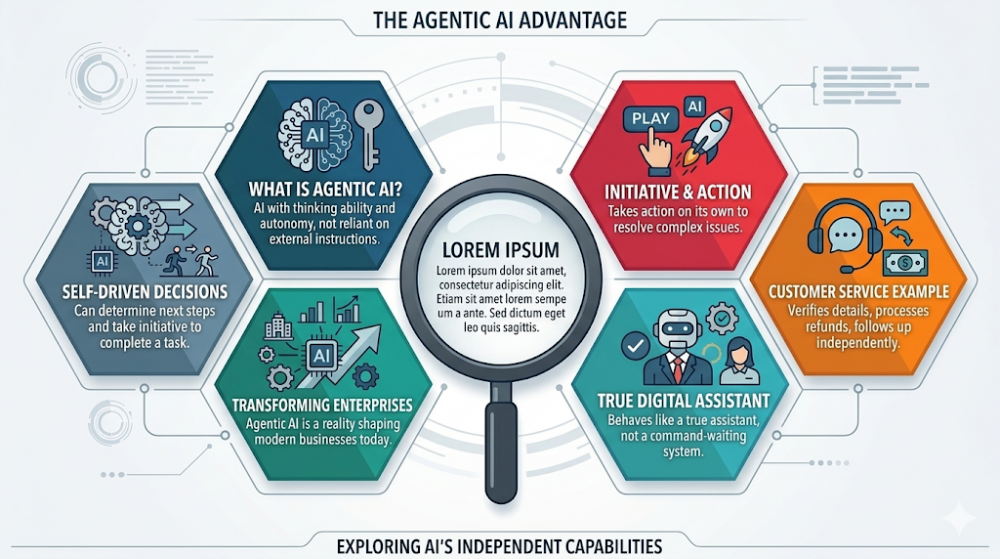
Agentic AI is a type of artificial intelligence that has its own thinking ability and autonomy. This is different from conventional AI because agentic AI does not rely entirely on external instructions or constant human guidance. It can take initiative, determine the next steps required to complete a task, and even take action on its own. This is one of the main reasons why many experts believe that agentic AI transforming enterprises is no longer just a question but a reality already shaping modern businesses.
An example of this would be an agentic AI system handling customer support queries. Instead of simply answering a question, the system can verify customer details, access internal databases, process refunds if necessary, and follow up with the customer after the issue has been resolved.
Agentic AI behaves more like a true digital assistant rather than a system waiting for commands. This ability to work independently and make intelligent decisions is what makes it highly valuable for today’s businesses.
Why businesses are shifting toward Agentic AI
The current business world is challenging; firms must move faster and more accurately than ever before. Customers are looking for instantaneous communications with businesses when they reach out for service, while also being accustomed to a quick and easy customer experience as well as personalized services.
Simultaneously, many companies are handling massive amounts of data across a variety of systems, with multiple complex work processes running concurrently, all while dealing with increasing levels of operational pressures. Agentic AI is transforming business operations by helping organizations reduce manual workloads through intelligent automation and smarter workflow management. Agentic AI helps alleviate some of the burden placed upon human employees by applying intelligent automation to repetitive/manual tasks and integrating process automation.
Instead of simply analyzing data, agentic AI can act on and implement changes based on that data in real time. In addition, automating entire workflows leads to increased cost savings for businesses because they no longer have to spend their time working on repetitive routines (i.e., process execution) or performing routine operations. The result allows teams to dedicate more time and resources to strategic planning, creativity, and decision-making processes, rather than routine business operations.
How Agentic AI is changing business operations
The increased use of agentic AI is changing the way that many different departments operate within an organization; in customer service, a chatbot used to be the norm, but now agentic AI is capable of resolving complex issues without having to rely on pre-defined templates. This is accomplished through accessing multiple systems, updating records, and ensuring compliance with established processes. According to market data published by Forbes India, early enterprise execution has yielded striking results, including a 25 percent drop in average call times for customer service and up to 60 percent faster content review cycles upon migrating from simple bots to adaptive workflows.
Benefits for next-generation businesses
There are many benefits to businesses using agentic AIs, including increased efficiency; they reduce complexity in executing time-sensitive processes. They help businesses become more profitable through better human capital utilization, as employees are able to concentrate their work efforts on tasks that require knowledge but do not require complex manual operations.
There are also many advantages in expanding an organization’s capacity. Growing companies will often face numerous operational challenges; therefore, it will be necessary for organizations to find ways to better manage their growth. Agentic AIs can manage increased workloads without needing significant additional resources, making growth much more manageable.
Another huge advantage is enhanced decision-making. The speed at which an organization can respond to market changes relies heavily on how quickly it is able to compile & analyze large volumes of data & then react. This kind of ‘agility’ is crucial for organisations operating under ‘time constraints.’
The ability to provide consumers with customized solutions is another significant reason to consider the use of agentic AIs. By understanding individual users’ behaviors & preferences at a deeper level than traditional systems, businesses using agentic AIs can develop completely personalized experiences for their customers, which ultimately increases consumer satisfaction and loyalty over the long term.
Challenges and considerations
While agentic AI has a lot of benefits, there are also challenges that come along with implementing this technology. The biggest challenge is control. Because agentic AI can be autonomous, businesses must ensure they have sufficient controls in place to prevent unintended consequences (i.e., harmful actions or mistakes).
Data privacy is a significant concern. Agentic AI relies on data to perform effectively, which means companies must responsibly manage sensitive data and abide by applicable laws and regulations.
Trust is also an issue. Many companies are still hesitant to allow AI systems to make decisions without receiving prior approval from a human being. To build trust in these types of systems takes time, testing, and a high degree of transparency.
Finally, there are many complexities associated with integrating agentic AI into existing business processes. Many companies still use outdated systems, and as such, it requires careful planning and investment to allow legacy systems to work effectively with agentic AI.
The future of Agentic AI in business
Moving into the future, agent-based AI is likely to become increasingly integrated into the daily operations of businesses. Rather than being contained to a single department, it will be used in multiple departments across an organization, providing intelligent integration of systems and workflows.
In the not-so-distant future, there is potential for collaborative AI agents to work together within an organization, handling all aspects of the business, from customer service to financial planning, with minimal human intervention. This does not indicate that humans will replace their job functions; rather, they will evolve into more supervisory, creative, and strategic roles.
As technology continues to evolve, it is likely that agent-based AI will eventually become ubiquitous in business processes, similar to what cloud computing has become today. Organizations that implement early into their business infrastructure could find themselves with a considerable competitive advantage in terms of efficiency, speed, and innovation.
Conclusion
Agentic AI isn’t merely an enhancement over traditional artificial intelligence; it signifies a transformative change in the way that businesses operate. By transitioning from being passive tools to active decision-making entities, companies can gain enhanced velocity, intelligence, and productivity through the use of Agentic AI.
Despite the ongoing challenges associated with concerns over trust, control, and integration, there is no doubt that the future of business will continue to be driven by agentic AI; it will increasingly define the methods of working and creating value in today’s dynamic business environment.