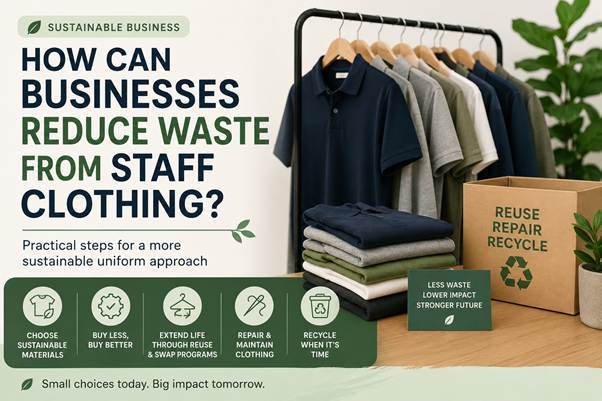
In today’s business environment, managing staff clothing efficiently has become an important part of sustainability and cost control. Most organizations are currently seeking means of reduce waste in staff clothing by enhancing planning and usage and disposal. Ineffective inventory management and recurring replacements and stock idleness are common causes of unnecessary textile waste which affects budgets and the environment.
It is at this point that having a sustainable uniforms supplier like Futuremind Uniforms will come in handy. With the right partner businesses can build smarter systems for professional clothing that focus on durability and reuse and responsible sourcing. By implementing systematic methods companies are in a position to enhance efficiency to a large extent as well as being long term environmentally responsible in the management of team apparel.
Smart Ways Businesses Can Reduce Waste from Staff Clothing
1. Plan Clothing Needs with Accurate Forecasting
One of the most effective ways to reduce waste in staff clothing is by improving demand planning. Ordering extra business is a common thing that happens when there is no clarity on the workforce information or the hiring decision is altered. Through the analysis of the number of employees their role demands and past utilization companies can only order what is necessary. This prevents stock wastages in the form of stock. More accurate forecasting also leads to less sizing errors and all garments have a distinct function.
2. Choose Long-Lasting and High-Quality Materials
Quality of workwear is a significant factor in minimizing waste. Poor-quality clothes deteriorate easily and require regular changing which raises the disposal levels. When investing in fabrics it is important to invest in durable fabrics that will last longer even in harsh working conditions. Good stitching and color and fabric retention are good and they prolong the life of the product. In the long run this streamlines the procurement processes and minimizes the total waste and enhances staff comfort and appearance criteria.
3. Set Up Repair and Care Programs
Businesses can repair and use damaged clothing rather than throwing them away as they become a bit worn. It is easy to repair small problems such as buttons that are loose, small holes or broken zippers. Frequent service inspections can also be used to detect early wear and avoid a total replacement. This will minimize unnecessary waste and enable companies to obtain more value out of existing inventory. It also promotes a culture of responsibility whereby clothes are utilized as a long term investment.
4. Reuse Clothing within the Organization
One of the strategies that can be used is reusing clothes within the company. When workers leave or switch positions their garments can be washed and reused by other people in case they are in proper condition. This minimizes the necessity of new purchases all the time and makes the most of what has already been on hand. Organized reuse system guarantees improved inventory management and it reduces significantly the textile waste in the organization.
5. Recycle and Upcycle Old Garments
Once the clothes are finished with their usefulness and recycling and upcycling are the solutions to the disposal. Companies can also collaborate with recycling programs of used textiles that recycle old fabrics to create new materials. Repurposing of some of the items can also be used in cleaning cloths or industrial use products. This promotes circular economy practices and aid in minimizing landfill wastes. It also enables companies to be more environmentally responsible.
6. Standardize Clothing Designs across Teams
There are usually numerous clothing styles in various departments which results in superfluous inventory that remains unused. The solution to this problem is to standardize designs to enable garments to be used across teams. This helps in reusing them better and minimizes the chances of stock becoming obsolete. It also eases the ordering and storage and distribution. The fewer variations will enable businesses to be more efficient in inventory management and minimize the needless production of new products.
7. Use Smart Inventory Tracking Systems
Online stock control systems enable companies to have a more effective control of clothing utilization. These tools track stock levels and employee requirements and replacement patterns in real time. Accurate data will enable companies to make the right purchase choices and prevent overstocking. This enhances efficiency and minimises unnecessary wastes due to poor visibility. It also makes sure that the clothing is discharged according to the real demand and not estimation.
8. Build Employee Awareness and Accountability
Workers are significant in minimizing the waste of clothing. Garment life can be greatly increased by proper care that includes proper washing and storage and handling. Educating employees on how to take care of clothes minimizes the repair and the rate of replacement. Clear returns also make sure that items are not lost in changing roles or exits. When employees are engaged in the process of sustainability the whole system will be more efficient and responsible.
Conclusion
Minimizing waste in personnel uniforms is not just a matter of decreasing costs but also a matter of creating a more sustainable and future-oriented business model. When organizations focus on better planning and longer lasting materials and smarter reuse systems they naturally cut down unnecessary textile disposal. Through these advancements a more efficient workflow is established and aids in the long term sustainability objectives in the operations.
In the long run companies that focus on organized clothing management are better in terms of environmental performance and control of expenses. By having regular practices and the appropriate advice of a trusted sustainable uniforms provider businesses can create a system that helps to maintain longevity and efficiency and sustainable use. This balanced approach helps ensure that efforts to reduce waste in staff clothing deliver lasting impact for both business growth and environmental care.