The primary purpose of tactical training is to develop a level of muscle memory that enables you to react to unexpected situations without thinking. Time is a key element of every tactical situation, and as little as half a second can make the difference between life and death in combat. If you train hard enough, you can reach a level of preparation that essentially negates the element of surprise achieved by unexpected moments in combat.
Dry Exercises
Before you even start taking down targets at the range, you need to devote a lot of time to dry exercises. This predominantly includes stances, fast switching between stances, and dry reloads.
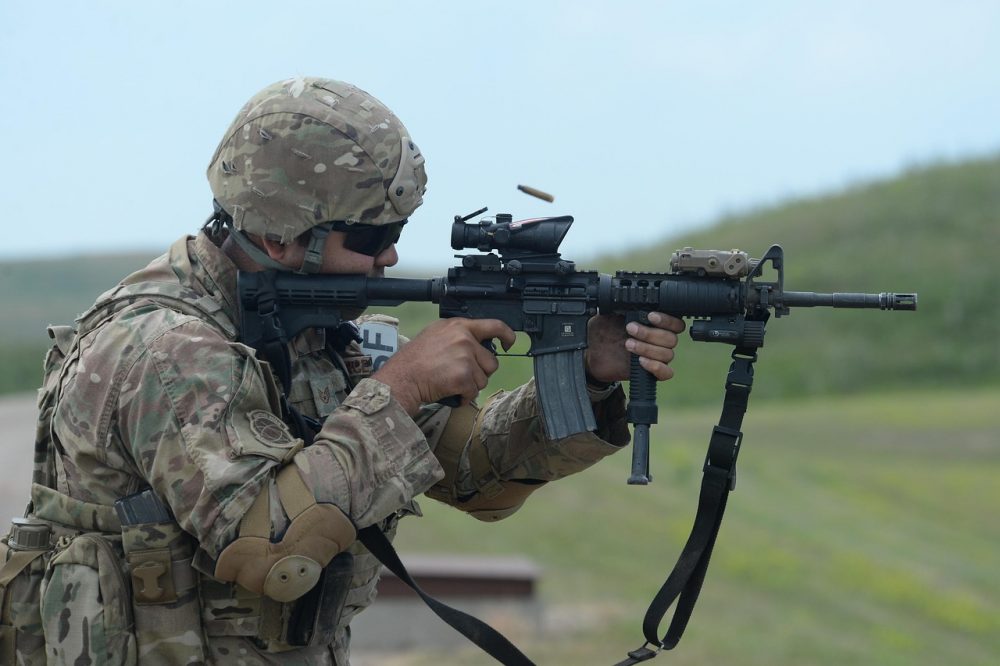
Practice your standing, kneeling, sitting, and prone stances with an empty firearm. This is going to feel a bit silly when you just start doing it, but by spending a few hours just pointing an empty firearm at a target, you’re going to perfect your stance. This will, in turn, minimize your profile and maximize your effectiveness.
Once you’ve mastered each stance, start practicing switching between them. Go from standing to kneeling, kneeling to standing, prone to standing, etc. By investing time in this type of exercise, switching from one to the other will become easy in the heat of battle, and you’ll take the perfect stance without having to think about it.
Finally, you should practice dry reloads. Reloads feel different in different stances, and when you start doing it, you’ll notice that it’s not as simple as just pulling one magazine out and inserting the other. Additionally, make sure to incorporate switching between stances and reloading at the same time. For example, go from standing to kneeling behind cover while reloading at the same time.
Reflex Shooting
Reflex shooting is quite possibly the most important aspect of tactical training when we’re preparing for the unexpected, and most agencies invest a lot of time in it. Getting in the right stance, taking aim, and opening fire all within a fraction of a second can make the difference between life and death. This is why dry stance exercises are so important.
There are many reflex shooting exercises you can do, and there are courses out there that specialize in it, but the most basic ones are quickdraw exercises, turn and shoot exercises, and moving target exercises.
Quickdraw
Quickdraw is the most straightforward type of exercise. Simply face the target with a round in the barrel, and your firearm in a low-ready position. Use a shot timer to time yourself, and try to get in the right stance and hit the target (accurately) as quickly as you possibly can. With enough practice, you’ll notice that you’re getting faster and more accurate.
Turn and Shoot
Turn and shoot exercises are almost identical, but they start by you turning your back or your side (either one) to the target. This exercise is great for practicing getting caught off guard. Use a shot timer to try to improve your turn, aiming, and firing speed.
Moving Target
Finally, we have moving target exercises. Some ranges have targets that pop up in a random order, and you can use them to test everything. You’ll never know what’s the next target, so you’re testing your reflexes, stances, and accuracy at the same time. When it comes to real-life applicability, this is the most useful exercise you should include in your tactical training.
Resolving Firearm Malfunctions
Something that a lot of people seem to forget when they’re setting up their tactical training is resolving firearm malfunctions as quickly as possible. This is a super useful exercise that you don’t even need a range for – you can do it at home.
The exact malfunctions depend on each firearm, but pretty much all gun parts can cause a malfunction, and there’s no greater fear than realizing your gun is blocked in the middle of a shootout.
Depending on how handy you are with firearms, it might take you anything from a few seconds to a few minutes to get your weapon to fire again. Still, if you practice enough, you can get that number pretty low and ensure that you’re never stuck with a useless firearm.
Conclusion
Before you start blowing holes in targets on the range, make sure to spend enough time on dry exercises to perfect your stances, switching between stances, and your reloads. After that, you can move on to reflex shooting exercises, but don’t forget to learn how to quickly take care of all misfires and malfunctions, as knowing how to remove a block can be just as important as shooting.