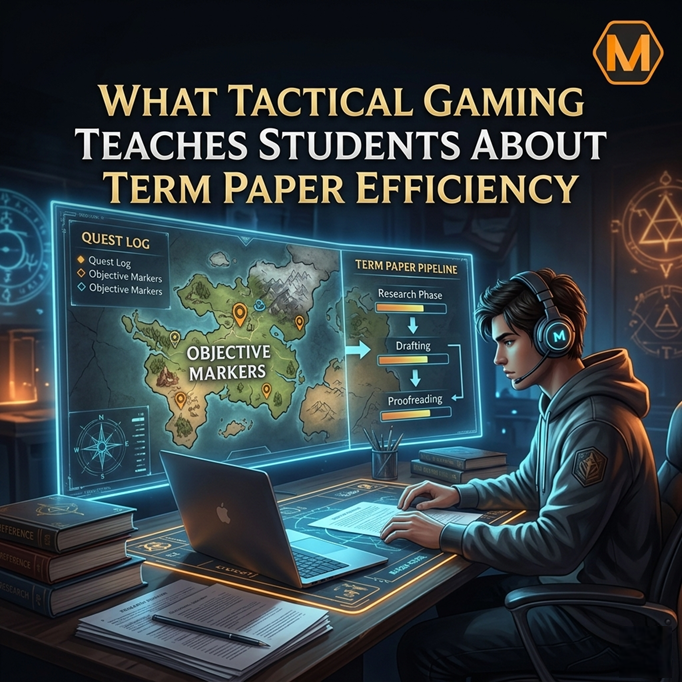
The intersection of tactical gaming and academic discipline is more than just a coincidence of hobbies; it is a profound overlap of cognitive strategies. When a student engages with a complex simulation like The Serpent Rogue, they aren’t just playing—they are managing resources, analyzing systems, and executing long-term projects under pressure. These are the exact skills required to navigate the rigors of an undergraduate degree.
The transition from a virtual world to the library stacks is smoother than many realize. In gaming, “management” is about maximizing the output of limited resources. Similarly, when a student seeks management assignment help, they are essentially looking for a way to optimize their academic “inventory”—time, research, and technical understanding. Applying a tactical mindset to your studies allows you to treat a 4,000-word essay not as a looming threat, but as a map that needs to be cleared, one objective at a time.
The Strategic Blueprint: Planning Your Academic “Campaign”
Every high-level tactical game begins with a “fog of war.” You don’t see the whole map at once; you only see what is directly in front of you. Term papers are identical. If you look at the final deadline as a single, massive obstacle, you are likely to experience “analysis paralysis.”
1. Resource Allocation and Mana Management
In tactical gaming, you have a limited pool of energy or mana. In college, your “mana” is your mental energy and time. Effective students treat their study sessions like a turn-based strategy game. You allocate forty minutes to high-intensity research (a “Heavy Attack”) followed by ten minutes of low-intensity organization (a “Cooldown”). By managing your cognitive load this way, you avoid the burnout that usually leads to last-minute, low-quality submissions.
2. The Logic of Systems Thinking
Modern management is less about telling people what to do and more about understanding how different systems interact. In gaming, changing one ingredient in an alchemical pot changes the entire potion. In an essay, changing your thesis statement changes every supporting paragraph. This high-level oversight is a skill that translates directly into professional success.
| Gaming Element | Academic Equivalent | Practical Application |
| Inventory Management | Source Organization | Keeping your Zotero or Mendeley updated. |
| Skill Trees | Subject Specialization | Building on foundational knowledge to tackle complex topics. |
| Boss Encounters | Midterm/Final Papers | Breaking the paper into phases (Intro, Body, Conclusion). |
| Crafting Recipes | Writing Frameworks | Using outlines to ensure all “ingredients” are present. |
Crafting the Narrative: Beyond the “Drafting” Phase
Writing a term paper is remarkably similar to a high-stakes crafting mission. You start with raw, unrefined materials—journal articles, data sets, and lecture notes. Your job is to refine these into a cohesive argument. This process requires a specific type of focus that many students find difficult to maintain over several weeks.
When the complexity of a project becomes overwhelming, many look for external guidance to ensure their research is sound. For instance, finding reliable term paper help through MyAssignmentHelp can act as a “guidebook” or “walkthrough” for students who are stuck on the structural nuances of their research. Just as a gamer uses a wiki to understand complex crafting mechanics, a student uses professional resources to understand how to format a bibliography or structure a literature review. This isn’t about taking shortcuts; it’s about utilizing every available tool in your arsenal to ensure the final product meets the high standards of 2026 academic excellence.
The “Information Gain” Factor in 2026
Google’s search algorithms and university professors are looking for the same thing: Information Gain. This is the idea that your paper shouldn’t just repeat what is already in the textbooks. It should provide a new perspective or a unique synthesis of ideas. In tactical games, players win by finding “meta” strategies that others haven’t discovered yet. In your writing, you win by finding a “meta” argument that connects two seemingly unrelated concepts.
Technical Optimization: How to “Level Up” Your Grades
To rank high in the eyes of your professor (and on the web), your content must be structured logically. Use the following “Tactical Study Framework” to organize your next major project:
The Discovery Phase (Quest Logging)
Before you write a single word, you must understand the “win conditions.” What does the rubric actually ask for? Create a checklist of every requirement. If you miss one “side quest” in your rubric, you lose points on the main mission.
The Grinding Phase (Research)
This is the most time-consuming part. You are collecting data points. To stay efficient, use a “tagging” system. Label your research papers by the specific paragraph they will support. This prevents you from having to re-read the same article five times.
The Final Boss (The Edit)
Never submit your first draft. In gaming terms, the first draft is your “Alpha Build.” It’s buggy and incomplete. The editing phase is where you “polish” the graphics and fix the logic errors. Read your paper out loud; if you stumble over a sentence, it means the “frame rate” of your writing is too low for the reader.
Conclusion: Embracing the Tactical Student Identity
The modern undergraduate student is a multi-tasker, a strategist, and a researcher. By viewing your academic challenges through the lens of tactical gaming, you remove the emotional weight of “failure” and replace it with a system of “optimization.” Whether you are mastering the intricacies of a virtual world or deep in the stacks of a library, the goal is the same: to manage your resources effectively and deliver a high-quality result. Use your tools, plan your turns, and approach every assignment with the intent to win.
Frequently Asked Questions
Q: How does gaming actually improve my writing speed?
Ans: Tactical gaming trains your brain to recognize patterns. Once you recognize the “pattern” of a standard term paper (Introduction-Context-Argument-Counter-Conclusion), you can fill in the sections much faster because you aren’t wondering what comes next.
Q: Is it “cheating” to use professional academic services?
Ans: Think of it as a “tutor” or a “mentor.” Using resources to understand formatting, structure, or complex management theories is a standard part of the learning process, provided you use the material to improve your own understanding and final output.
Q: What is the best way to manage a heavy workload during finals?
Ans: Use the “Quest Log” method. Break every large paper into five small tasks (e.g., “Find 3 sources,” “Write Intro”). Only focus on one task at a time to keep your “Mental Mana” high.
Q: Why is “Information Gain” important for my grades?
Ans: Professors read hundreds of essays on the same topic. If you provide a unique insight or a fresh analogy (like comparing gaming to management), you stand out from the crowd, which typically leads to higher marks.