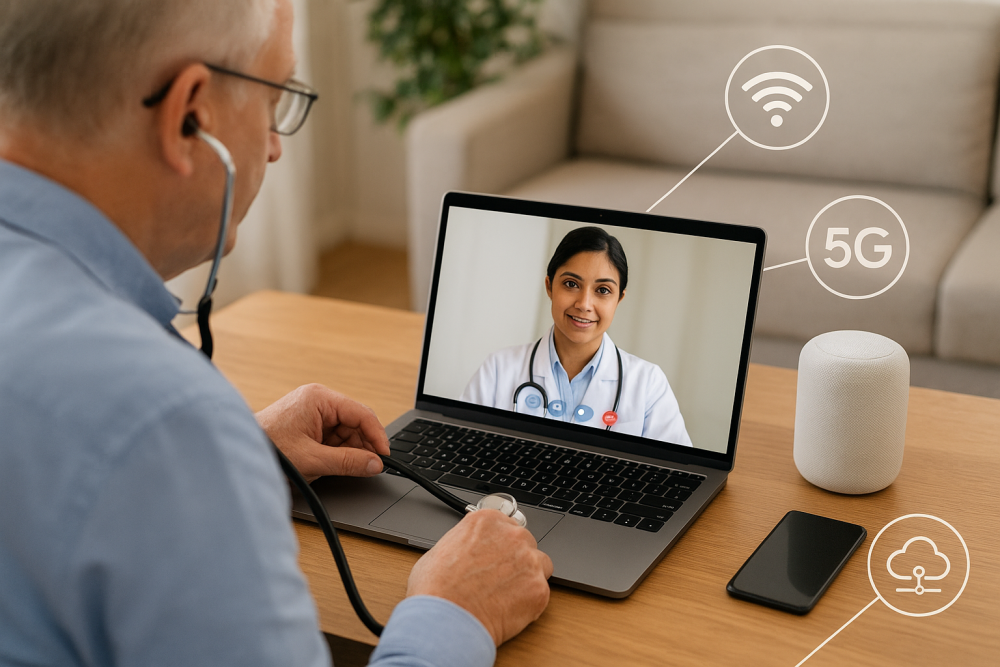
Telemedicine is no longer just a convenient supplement to traditional healthcare; it is one of the major ways in which people get medical care globally. The scope of telemedicine, which was initially confined to straightforward consultations or follow-ups, has now evolved into a network that enables live diagnosis, remote monitoring, and care that is accessible to anyone.
The expansion of this service is not only a response to the patients’ demand for more convenient options, but also a consequence of the technological innovations that make remote healthcare more trustworthy and efficient. The three main technologies at the core of this revolution are IoT, 5G, and edge computing, which are interlinked and are changing the face of telemedicine.
The Digital Shift and the Rise of Remote Healthcare
Over the last couple of years, telemedicine has been largely embraced globally. Factors such as increased healthcare demands, the rising incidence of chronic diseases, shortage of healthcare workers, and the existence of barriers due to the geographical location have been major contributors to this trend. The ease which remote consultations can be done, and the fact that one can monitor his/her health without going to the hospital frequently has made digital care solutions more attractive than ever before.
Nevertheless, the growing adoption of sophisticated technologies that enable data gathering, data processing, and data communication in real-time is the main factor that has led to the change of remote health care model. All these functions demand quick connection, smart gadgets, and efficient data processing, which are some of the characteristics of IoT sensors, 5G networks, and edge computing systems.
IoT in Healthcare: Connecting Patients and Providers
The Internet of Things (IoT) is a network of devices that are linked to each other, can gather information and share it. IoT in healthcare means the use of wearables, implantable sensors, home monitoring devices, and smart medical equipment.
They enable telemedicine to be more efficient through the integration of technologies that make health monitoring continuous, diagnostics remote, and insights individualized. Wearables and biosensors measure and record the live metrics of the body such as the pulse, blood sugar level, oxygen concentration, and blood pressure, thus patients are given fifteen minutes monitoring as normally done by these devices. The continual output of data gives clinicians the power to make timely decisions, at the same time, unnecessary visits to healthcare facilities are avoided.
Besides offering comfort, IoT devices are capable of early support as they allow the prompting of the caregivers when changes occur that can be wrong and also it is very advantageous to people who have chronic diseases to manage them efficiently.
The data accumulated by these devices will, over time, create comprehensive patient records which will enable the provision of more personalized treatment plans. IoT-powered remote monitoring is a source of medical supervision that is continuous and without the inconveniences of travel or long waiting times, thus, it is a blessing to patients residing in remote areas or those that are deprived of medical resources.
5G and Its Impact on Remote Healthcare
Though IoT devices produce valuable data, telemedicine still requires that data to be sent quickly and reliably if it is to work effectively. And this is the place where 5G networks come to rescue with their critical role. 5G is providing the backbone needed for a seamless virtual care due to its faster speeds, higher bandwidth, and significantly lower latency than previous cellular generations.
First of all, it is video consultations in high resolution that can be easily and effectively implemented due to the presence of 5G. Next, the transfer of medical imaging becomes almost instantaneous and finally, communication between providers and patients can even be in real-time, and all these processes are supported by 5G connectivity.
Additionally, 5G’s low latency is very much needed for situations where time is of the essence. The data that is needed to be exchanged in such a split second way are remote robotic surgeries, real-time imaging diagnostics, AR-based therapies, and connected ambulances.
Furthermore, 5G with more stable connections and the capability to support a large number of devices simultaneously allows healthcare professionals to become even more accurate and responsive in their interactions with patients and systems than ever before. Also, it is only due to the 5G network that advanced telemedicine scenarios which were limited due to network restrictions can be realized now.
Edge Computing: Enabling Real-Time Decision-Making
As a result of IoT devices, medical data is becoming very voluminous. This trend has made it completely inefficient and, in some cases, even risky to rely solely on cloud processing. To solve the problem, edge computing is used to locally process data that is generated close to the source rather than send everything to cloud servers that are far away.
By eliminating almost all the waiting time, this localized approach also improves security, reduces the amount of data sent over the network, and makes sure that critical insights are delivered to clinicians without any delay.
Edge computing in remote healthcare allows smart medical devices to perform patient data analysis on the spot and instantly issue a warning if there is a problem. For instance, a heart monitor with edge capabilities can recognize abnormal rhythms and thus be able to give the first immediate warning without cloud-based analysis waiting time.
The availability of such a feature is life-saving at times of emergencies, especially those patients with chronic diseases who are highly dependent on timely interventions. Consequently, the use of edge computing in telemedicine systems makes them more efficient in terms of time and also reliable.
How IoT, 5G, and Edge Computing Work Together
While IoT, 5G, and edge computing individually offer great advantages in the healthcare sector, their combined power is simply phenomenal.
IoT devices gather continuous patient data, 5G networks deliver that data at high speed and with great reliability, and edge computing gets to work with the data right away to offer useful insights. Together, they form a connected system that, among other things, makes teleconsultations run smoothly, remote monitoring more efficient, diagnostics smarter, and medical decisions quicker.
This trio is particularly crucial in cases where fast and accurate information can be instrumental in saving lives. Doctors in remote ICUs are able to monitor more patients simultaneously, and connected ambulances, therefore, can transmit crucial details to hospitals even before the patient’s arrival.
The intelligent gadgets, consequently, are useful in the homes of the elderly and sick patients by securing the surroundings and allowing the patients to be self-reliant. Moreover, these breakthroughs are turning clinical research into a new world, where virtual rehab programs, AI-based analysis, and decentralized medical trials are all coming together to form a healthcare system that is not only efficient but also easily accessible to people.
Real-World Applications Shaping the Future
The integration of IoT, 5G, and edge computing is revolutionizing the healthcare industry in many parts of the world. Remote patient monitoring systems provide clinicians with real-time data which enables them to detect health risks at an early stage. The healthcare industry is getting smarter with the introduction of different connected devices to improve the workflows, optimize the resources, and extend the specialist care through tele-ICUs.
Various solutions including fall detection, medication reminders, and environmental sensors are employed to enhance the safety of patients and reduce hospital admissions in home care. Besides, emergency response teams become more efficient with the help of connected ambulances that provide real-time data to hospitals thus enabling medical staffs to get prepared even before the patient arrives.
Fast data transfer and local processing are the major enablers of AI-assisted diagnostics which guide clinicians to quickly and accurately analyze the imaging, symptoms, and vital signs of patients. This will not stop the evolution of technology-powered care which will keep on integrating machine learning, robotics, and advanced analytics into the everyday routine of care.
Challenges to Overcome
Next-generation telemedicine is very promising but, at the same time, it also presents challenges that need to be resolved carefully. The growing amount of connected medical devices results in the risk of cyberattacks rising, thus data security and patient privacy should be the top priority. Besides, 5G network and edge computing infrastructure installations can be expensive, especially in remote areas or regions with low levels of development.
Healthcare systems are also grappling with the problem of interoperability due to the fact that devices and software from different manufacturers are often not compatible. Furthermore, the existence of regulatory requirements and the low level of digital skills among some users make the uptake of these technologies more difficult.
There is a need for healthcare providers, technology companies, policymakers, and standards organizations to collaborate in order to resolve these issues. It will be crucial in creating the conditions for the full use of new technologies to have telemedicine systems that are secure, compatible, and user-friendly.
The Future of Telemedicine
The future of telemedicine is a predictive, personalized, and connected healthcare environment. The hospital at home concept along with advances in IoT devices, 5G adoption, and more powerful edge computing systems will allow healthcare to become more proactive and to identify potential problems before they become serious.
We will see intelligent medical devices capable of making decisions on their own, fully integrated virtual care platforms, and AI-driven predictive analytics helping clinicians in their daily practice.
When this ecosystem gets to its full potential, telemedicine will not only be a safe alternative to traditional healthcare but it will lead to the regrowth of healthcare, making it more accessible, fair, and efficient for communities all over the globe.