A founder from Lahore got in touch with me a few months back. His business was solid: fifteen years old, profitable, generating real export revenue, and supported by a factory with real equipment and orders. For nearly four months, he’d been talking with a Singapore-based private equity firm.
But the deal fell apart during due diligence.
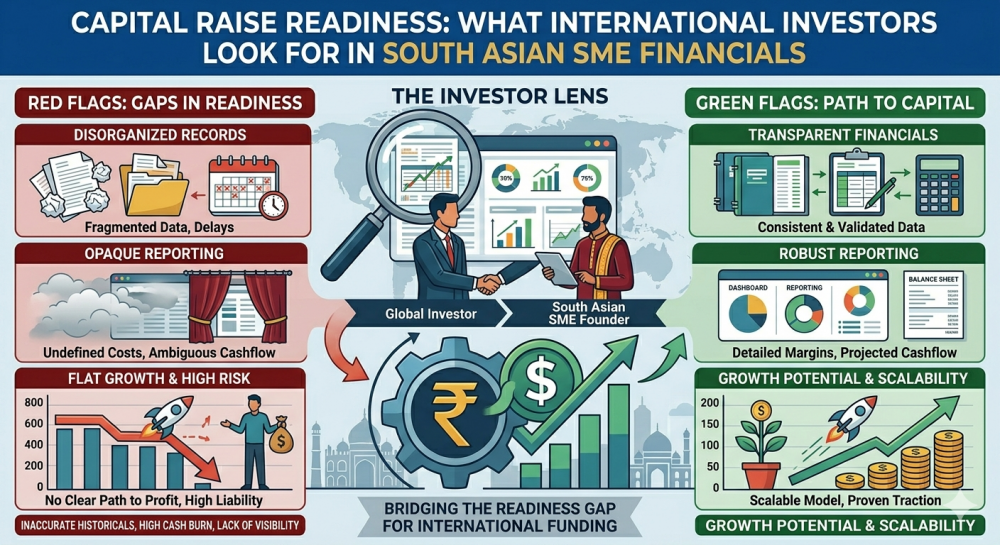
Not because the business was bad, but because his books were a mess. He kept two sets of accounts. Revenue was recognized every time cash hit the bank. There was no segment-level margin data. Personal expenses ran through the company P&L in ways that were hard to explain.
The investor walked away. The founder was genuinely shocked, because in his world, this way of managing finances was completely normal.
That gap, between what’s normal locally and what international investors expect, is what this article is all about.
The Quiet Reason Most South Asian SMEs Don’t Close
From the textile corridors of Faisalabad to the garment hubs of Dhaka to the IT parks outside Bangalore, there’s no shortage of genuinely good businesses. International investors—PE funds, development finance institutions, diaspora capital, venture money—know this. They’re actively looking.
But a striking number of deals never close. And when you dig into why, it’s rarely the business model. It’s the financials. Specifically, the gap between how South Asian SMEs manage their books and what a globally-trained due diligence team expects to find when they open the data room.
This isn’t a criticism of South Asian business practices. It’s just a gap that exists, and one that’s entirely possible to close if you start early enough.
1. Clean, Audited Books — No Exceptions
The starting point is non-negotiable. Any serious international investor will want three years of independently audited financial statements: income statement, balance sheet, cash flow statement, and notes to accounts.
The double-books problem is more common than most founders admit. There’s often one set for the tax authority, another for internal management. International investors aren’t naive; they look for this specifically. And when they find inconsistencies, the deal doesn’t just slow down. It stops.
Consolidating to a single, transparent set of accounts isn’t something you scramble to do the week before a fundraise. Give yourself at least 12 to 18 months. The history needs to be clean, not just the current period.
2. IFRS or GAAP — Because Your Local Standard Isn’t Their Local Standard
ICAP, ICAI, ICAB are all legitimate accounting frameworks. But international investors work within IFRS or US GAAP, and when your statements don’t map cleanly to those standards, it creates friction that slows everything down and sometimes creates mistrust.
The areas where local standards typically diverge from IFRS are predictable: revenue recognition under IFRS 15 is stricter than most SMEs are used to, lease accounting under IFRS 16 puts operating leases on the balance sheet (which changes your debt picture), and fair value measurements for financial instruments are handled differently.
Full conversion to IFRS before a raise isn’t always realistic. But preparing a reconciliation bridge, showing how your local numbers map to IFRS, is. It shows sophistication and saves the investor’s team a lot of time during due diligence.
3. Revenue Recognition: The Detail That Quietly Kills Deals
International investors, particularly those from North America and Europe, are almost paranoid about revenue recognition. And honestly, they’ve earned the right to be. They’ve seen too many deals where revenue was front-loaded, where related-party transactions inflated the top line, or where cash-basis accounting was dressed up to look like accrual reporting.
The red flags are familiar: revenue booked before delivery, unearned revenue not deferred properly, and related-party sales at prices that aren’t arm’s length.
If your business involves long-term contracts, milestone-based delivery, or subscriptions, your account notes should spell out your revenue recognition policy clearly. It’s one of the best things an SME can do to build investor confidence early.
4. Gross Margin by Segment — Not Just One Blended Number
Most South Asian SMEs present consolidated top-line financials. One revenue number, one gross margin. Investors find this frustrating because blended margins hide what’s actually going on inside the business.
If a Pakistan-based textile exporter reports a 31% gross margin overall, that number could be masking an export business running at 40% and a domestic business at 18%, with the domestic segment quietly dragging things down. Investors want to see that breakdown. More than that, they want to know you see it, understand it, and have a plan for what to do about it.
Segment-level margin data over three to five years also tells the story: pricing power, operational efficiency, and whether the business is getting better or just bigger. That distinction matters a lot when investors are modeling returns.
5. Working Capital — The Number That Determines How Much Cash Your Growth Will Eat
For manufacturing, trading, and distribution businesses (which is most of South Asia’s SME backbone), working capital management is often where international investors spend the most time.
They’re calculating four things: Days Sales Outstanding (how long it takes you to collect), Days Inventory Outstanding (how fast stock moves), Days Payable Outstanding (how long you take to pay suppliers), and Cash Conversion Cycle, the combination of all three.
A high cash conversion cycle means the faster you grow, the more cash you’ll burn before you see it back. That directly affects how much equity an investor needs to put in and what their return model looks like.
For many South Asian SMEs, this challenge is structural. Government clients and big corporates in Pakistan and Bangladesh often pay 90 to 120 days late. That’s not a management failure; it’s just how the market works. But investors need to see that you get this, that you can quantify it, and that you’ve got a plan to manage it instead of just hoping it improves.
Using proper working capital modeling tools to present these metrics in a format investors recognize, not just a spreadsheet you pulled together at the last minute, shows you run a tighter ship than most.
6. Adjusted EBITDA: Show Your Work
Reported EBITDA is almost never what international investors use for valuation. They build their own adjusted EBITDA, stripping out the things they consider noise: one-time items, owner compensation above market rates, related-party rent that isn’t arm’s-length, non-cash items that shouldn’t be running through the P&L.
This is especially common in family-run South Asian businesses. The owner might pay themselves a below-market salary (to minimize taxes) and route personal expenses through the business. Neither is unusual. But it means the reported EBITDA doesn’t reflect the true economics of the business.
The smart move is to build your own EBITDA bridge before anyone even asks for it: a simple, transparent walkthrough from reported to adjusted EBITDA, with explanations for every line. Do it proactively and you build trust. Make an investor hunt for these adjustments and you create suspicion.
7. Debt Schedule — No Surprises Allowed
Nothing derails a late-stage deal faster than a debt surprise. International investors want to see everything: all bank facilities and their terms, secured versus unsecured borrowings, any personal guarantees given by founders or directors, covenant compliance history, and shareholder loans.
South Asian SMEs often have layered, complex borrowing arrangements: SBP refinancing schemes, rotating credit facilities, even informal family loans that never made it onto the balance sheet. These aren’t necessarily deal-killers, but hiding them definitely is.
Prepare a clear debt schedule before your first investor meeting. Include covenant compliance certificates. If there have been technical breaches, explain them upfront and share how you resolved them. Investors can handle complexity. What they can’t handle is being blindsided by surprises.
8. Tax Exposure — Get Ahead of It
Pending tax assessments, informal arrangements with local tax authorities, transfer pricing risks in group companies, GST reconciliation gaps—these are common in South Asian SMEs and they’re among the first things an international investor’s legal and financial team will probe.
Get a tax health check before you start fundraising. Prepare a contingent liabilities schedule that lists known and potential exposures, with honest probability assessments. Yes, it means disclosing things that might feel uncomfortable. But showing up to due diligence with a clear, organized view of your tax risk tells an investor far more about your management character than any financial model ever could.
9. Financial Projections — Build From the Ground Up
“We’re targeting 2% of a $5 billion market.” International investors have a word for this kind of projection, and it isn’t a compliment.
Top-down projections feel lazy to investors. What they actually want are bottoms-up models built from operational reality: number of customers times average order value, production capacity times utilization rate, salespeople times average deal size. Real drivers, not just percentages applied to big market numbers.
Projections should cover five years, with monthly detail for the first two. Spell out every assumption; don’t bury or imply them, so investors can stress-test things themselves. And your model needs three scenarios: base, upside, and downside. If you only show the upside, you’re signaling either naivety or something worse.
Getting help from real startup fundraising consultants to build and pressure-test your financial model is one of the best investments a South Asian SME can make before entering a formal raise. The cost is small compared to what a failed due diligence process can cost in time, reputation, and opportunity.
10. FX Risk — Don’t Pretend It Isn’t There
South Asian currencies are volatile. PKR, BDT, INR—none of these are stable stores of value, and international investors know it. What they want to know is whether you know it, and what you’re doing about it.
If your business has export revenue, relies on imported supplies, or has USD-denominated debt, your financial model needs to address FX exposure directly. What percent of your revenues and costs are in foreign currency? Do you hedge, and if so, how? What happens to your P&L if the PKR drops 15%?
SMEs that model everything in local currency without stress-testing currency scenarios are giving investors a reason to discount the valuation. Don’t give them that reason.
11. ESG — Not Just a Box-Ticking Exercise
Development finance institutions — IFC, DEG, FMO, and others — along with a growing number of impact-focused PE funds, are now requiring ESG disclosures as part of the standard financial package. Even investors who don’t explicitly require it are increasingly rewarding businesses that demonstrate awareness.
For South Asian SMEs, this means practical things: board composition and governance policies, labor practices and worker safety records, gender diversity data, and for manufacturers, basic environmental metrics like energy and water use.
You don’t need a full ESG report. You just need to show you’ve thought about it, have some policies in place, and aren’t one investigative article away from a reputational crisis. Institutional investors building long-term positions care about this more than most founders realize.
12. The Data Room: How You Present Is Part of What You’re Presenting
When an international investor gets a disorganized pile of PDFs in a shared WhatsApp folder, they draw conclusions about management quality, and often, they’re not wrong.
A well-structured data room, organized by section, clearly labeled, and complete, signals competence, transparency, and respect for the investor’s time. It’s a soft signal, but sophisticated investors pick up on it instantly.
The standard sections are straightforward: corporate documents, three years of audited financials plus projections, legal contracts and IP registrations, tax filings and contingent liability disclosures, operational data, and market context. Using proper investor-grade document templates to assemble this package ensures it meets the format international investors expect, rather than requiring translation.
The Gap Is Real. It’s Also Closeable.
Here’s what gets lost in these conversations: international investors aren’t looking for perfection. They’re looking for transparency, consistency, and a management team that actually understands its own numbers.
The South Asian SMEs that successfully close international raises aren’t always the ones with the strongest businesses. They’re the ones who treated financial readiness as a strategic priority, cleaned up their books a year before the raise, got the right advisors involved early, built models from the ground up, and organized their documents before the first meeting instead of scrambling at the last minute. If you’re thinking about raising international capital in the next year or two, the best time to start preparing was twelve months ago. The second-best time is now.