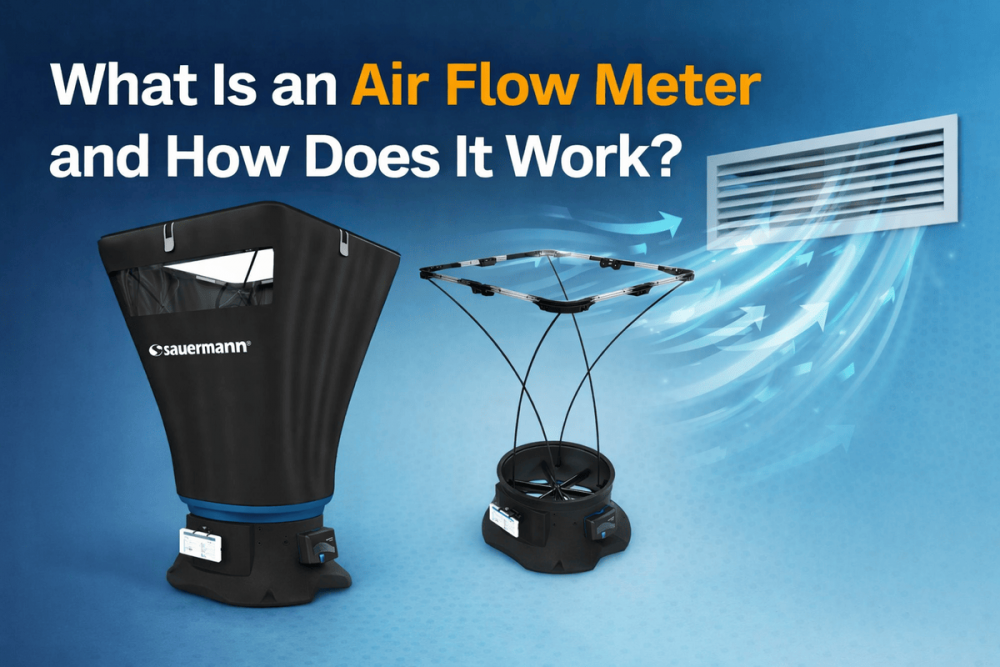
Air is invisible. But in HVAC systems, factories, clean rooms, and labs, air movement is serious business. You cannot manage what you cannot measure. That is why an air flow meter is used there.
If you are dealing with ventilation systems, air ducts, exhaust lines, or indoor air quality, you need to know how much air is moving. Too little airflow creates problems. And too much airflow wastes energy. An air flow meter helps you check that.
What Is an Air Flow Meter?
An air flow meter is a measuring instrument used to check the nonlinear volumetric or mass flow of air. In simple words, it checks the speed and volume of air moving through a system.
It tells you:
- Air velocity
- Air volume (like CFM or m³/h)
- Sometimes temperature
It is widely used in HVAC systems, air conditioning maintenance, ventilation balancing, and industrial airflow monitoring.
Why Measuring Airflow Is Important
Measuring airflow is very important. Because if the airflow is wrong, your HVAC system starts working harder. That means more electricity, more wear, and more problems later. In factories, poor airflow can disturb the whole process.
When you measure air properly, you can spot leaks, fix imbalances, and keep the system running fine.
Key reasons for measuring airflow include:
- Energy Efficiency & Cost Savings
- System Performance & Maintenance
- Indoor Air Quality (IAQ) & Comfort
- Safety & Regulatory Compliance
- Process Control
- Equipment Longevity
How Does an Air Flow Meter Work?
There are different types of air flow meters that work in different ways. But their working method is the same. Like they detect air movement and convert it into readable data.
1. Vane Type Air Flow Meter
The vane-type airflow meter uses a small rotating fan (vane). When air passes through, the vane spins. The speed of rotation is measured. If the spin is very fast, it means there is higher air velocity. It is commonly used in duct measurements and ventilation systems.
2. Hot Wire (Thermal) Air Flow Meter
The hot wire meter uses a heated sensor. When air flows across the heated wire, it cools it down. The instrument measures how much cooling happens. For example, more cooling means more airflow. These types of airflow meters are sensitive and good for low airflow measurement.
3. Pitot Tube Air Flow Meter
The pitot tube airflow meter measures pressure difference. Air moving inside a duct creates pressure. The meter compares static pressure and dynamic pressure to calculate velocity. It is commonly used for professional duct testing.
Where Is an Air Flow Meter Used?
Airflow meters, also known as airflow sensors or anemometers, are very important tools which are used in different industries to measure the volume, velocity or mass of moving air. These devices are used, in simple terms, to provide data for process control, safety monitoring, and energy efficiency.
Like:
- Automotive Systems
- Industrial Manufacturing & Utilities
- HVAC and Building Safety
- Medical & Environmental
About Kimo Instruments
Kimo Instruments has been working in this industry for years. We design professional measuring instruments for HVAC and industrial applications. Our air flow meter range includes portable and accurate solutions built for real-world field testing.
When airflow measurement needs to be precise and reliable, the right instrument makes all the difference.
Final Thoughts
We cannot see air, but its movement affects everything like comfort, efficiency, and safety. An air flow meter is the right tool which you can use to measure the air speed. With this device,you get to know the real speed.
If you work with HVAC or ventilation systems, airflow measurement is a very important practice. And with proper tools from trusted manufacturers like Kimo Instruments, you can measure and make your workings smooth.